

Eco-driving lessons teach fuel-efficient habits such as smooth acceleration, early hazard anticipation, steady speed, reduced unnecessary idling and efficient route planning. In Ontario, eco-driving is not a separate regulated licence class. It is usually a focused part of individual or defensive-driving instruction, with safety and vehicle control always taking priority.
What eco-driving lessons mean in Ontario
Eco-driving means operating a vehicle in a way that avoids unnecessary fuel use, emissions and mechanical wear while maintaining safe control. It focuses on how you observe traffic, choose speed, accelerate, brake, plan trips and respond to changing conditions.
Ontario’s Beginner Driver Education curriculum includes environmentally conscious and efficient driving behaviour, including fuel efficiency, route planning and vehicle-related environmental considerations. Ontario’s BDE curriculum standards provide the relevant framework.
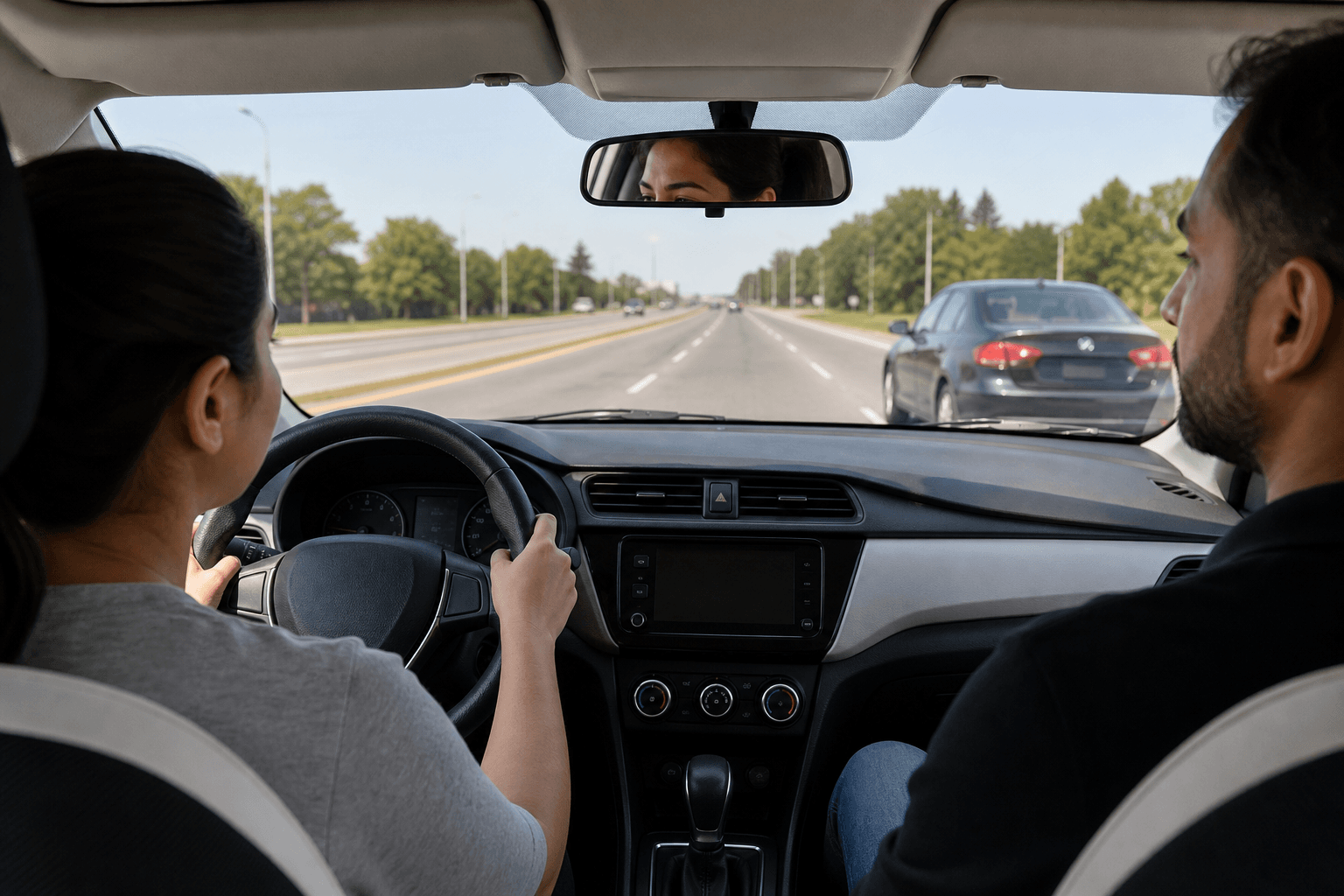
A coached lesson is different from reading a list of sustainability tips. An instructor can observe whether you accelerate sharply, follow too closely, brake late, leave the vehicle idling unnecessarily or miss opportunities to anticipate traffic. You then practise those habits in real road conditions and receive immediate feedback.
What eco-driving can achieve without unsafe promises
Eco-driving can help you use fuel more deliberately, reduce unnecessary emissions and develop smoother vehicle control. It can also support safer observation because efficient driving depends on looking farther ahead, anticipating traffic and avoiding abrupt decisions.
Natural Resources Canada says fuel-efficient techniques can reduce fuel consumption and carbon dioxide emissions by as much as 25% in some circumstances. That is not a guaranteed result for an individual learner. Vehicle type, route, weather, traffic, driving baseline and consistency all affect the outcome. Natural Resources Canada’s fuel-efficient driving guidance explains the potential benefits without promising a fixed saving.
Is driving on eco better? It is better when it means smoother, more anticipatory and less wasteful driving without reducing your safety margin. It is not better if you delay a necessary response, drive too slowly for conditions or focus on fuel use instead of a developing hazard.
What happens during an eco-driving lesson
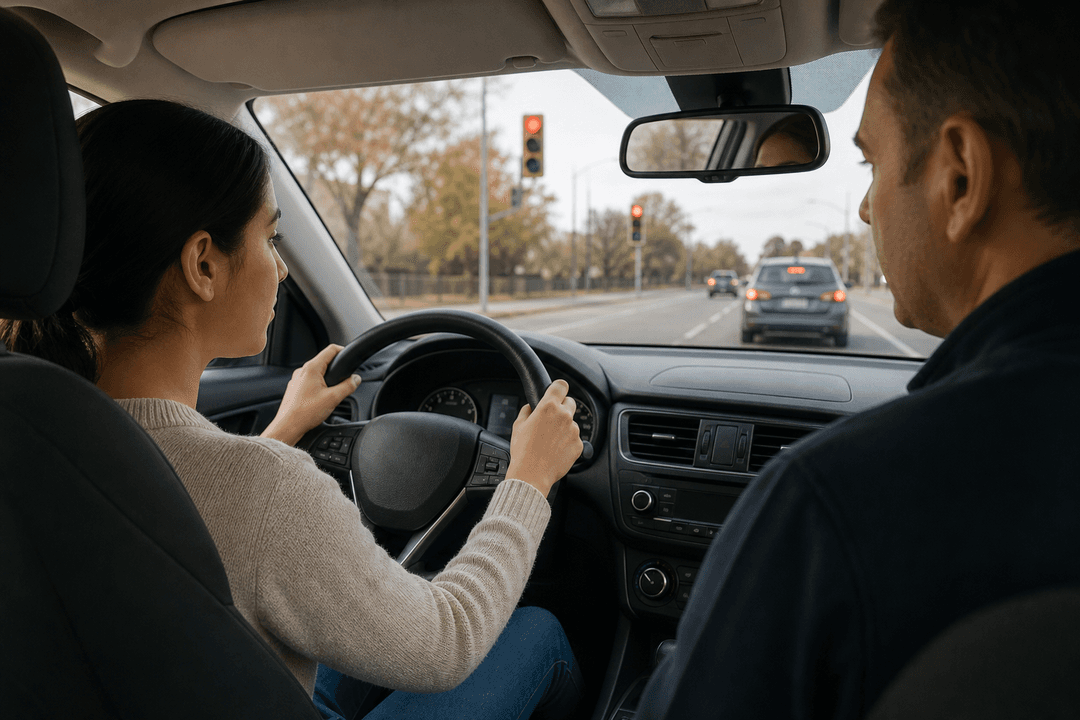
A useful session turns broad advice into observable driving behaviours. The exact route and exercises depend on your licence stage, experience, vehicle and goal, but a realistic lesson can follow five stages.
1. Set the goal and establish a baseline
Start by discussing what you want to improve. You may be a new driver learning smooth control, a commuter reducing harsh braking, a returning driver rebuilding confidence or a G2 candidate seeking efficient habits without compromising test standards.
The instructor can observe a normal drive, including starts, intersections, lane changes, following distance, speed changes, braking and stationary time. This identifies the habits worth practising instead of filling the lesson with generic advice.
2. Demonstrate one technique at a time
The instructor can demonstrate a smooth start, progressive acceleration, early scanning and a controlled approach to a red light or stopped vehicle. Demonstrating one change at a time helps you connect what you see with how you operate the car.
The goal is not to drive unusually slowly. It is to use the necessary amount of power and braking while leaving enough space to respond calmly.
3. Practise in changing traffic
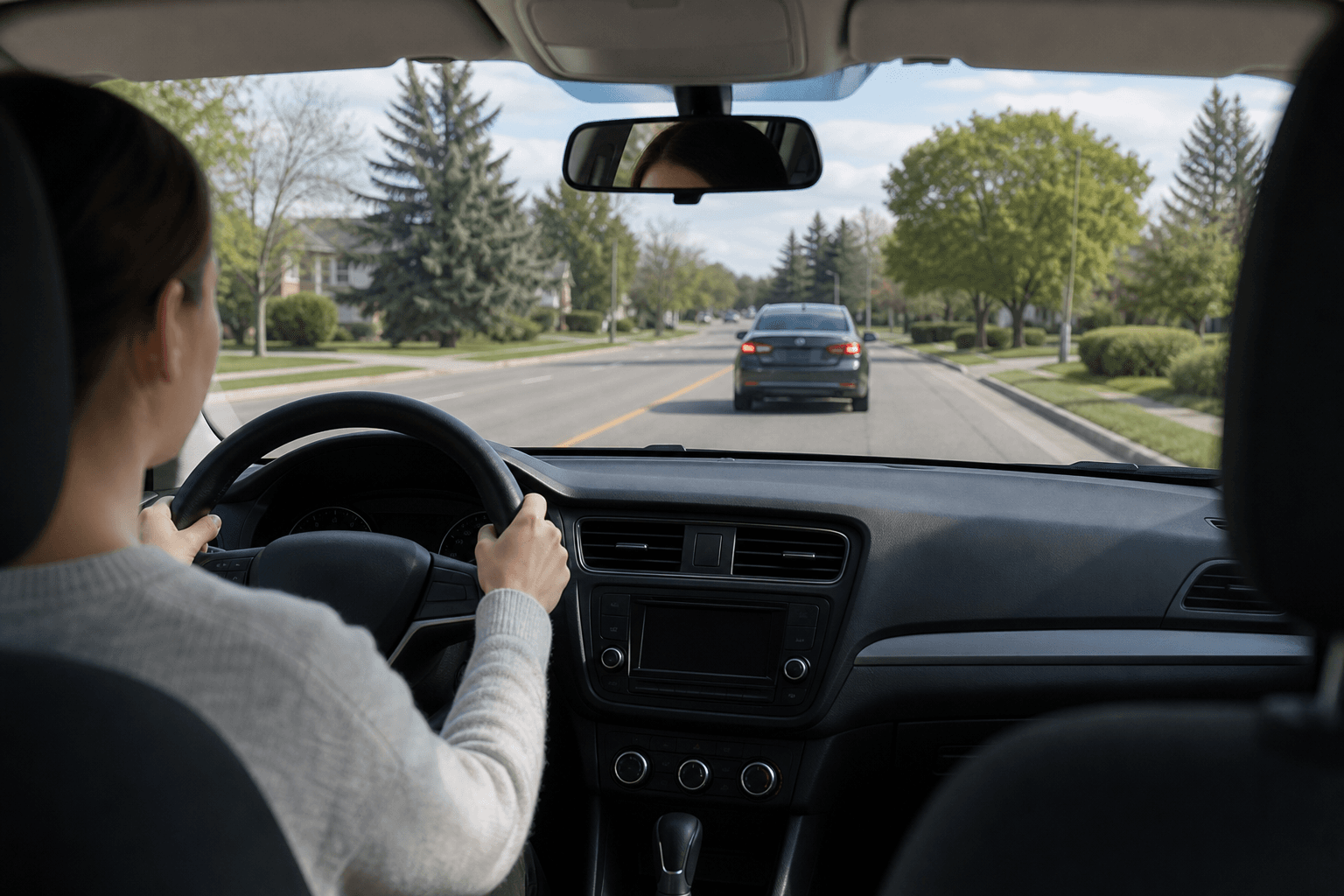
Repeat the skills on residential streets, arterial roads, intersections and stop-and-go routes. A lesson might compare late braking with an earlier scan that lets you ease off the accelerator sooner, provided your road position and following distance remain safe.
In Mississauga, this practice can connect fuel-efficient habits with observation, signalling, gap selection, speed control, space management and hazard anticipation. Those skills support both daily travel and road-test preparation.
4. Review the decisions, not only the result
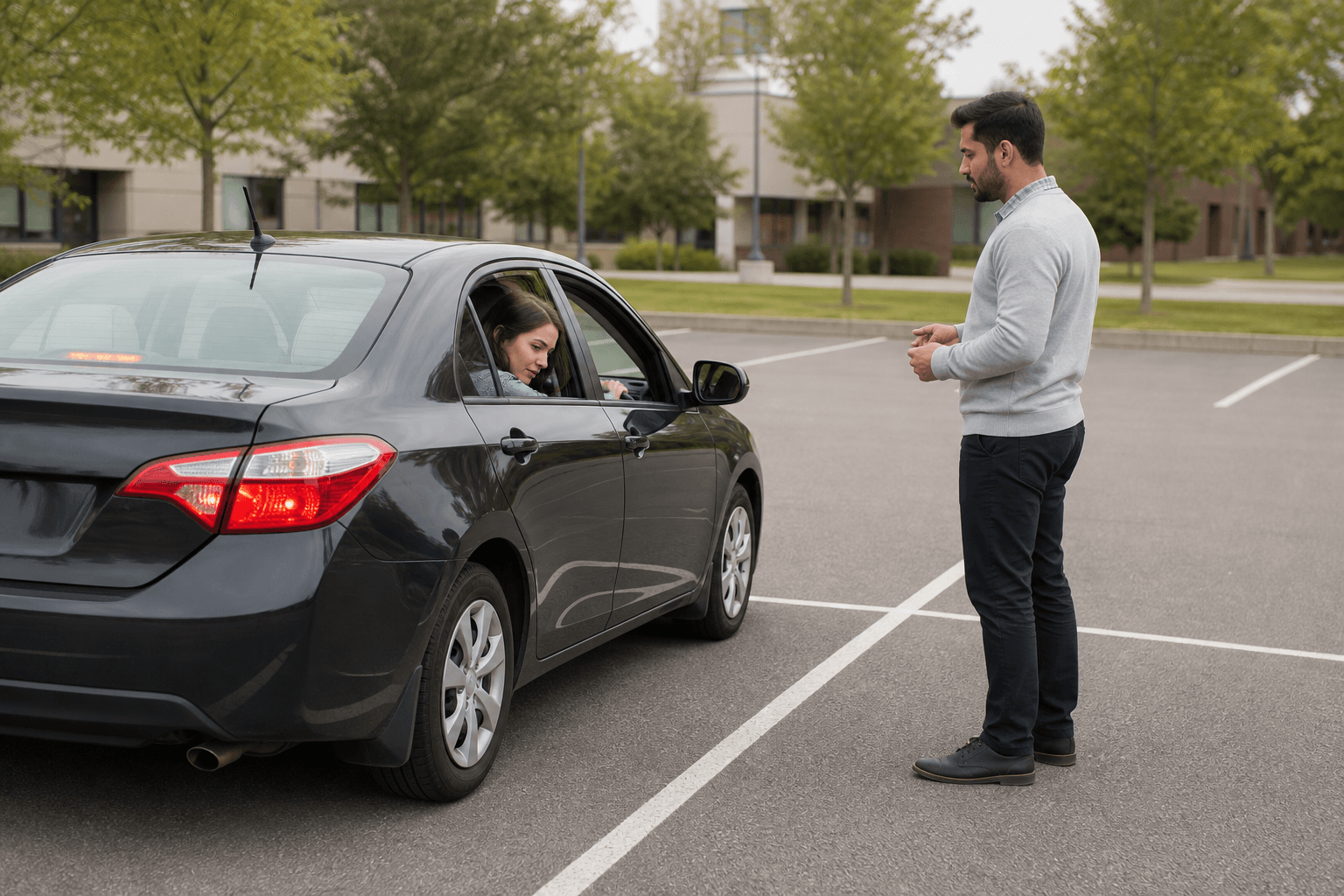
Feedback should explain why a choice was efficient or wasteful. The issue may not be the final brake application. You may have looked too close to the vehicle ahead, noticed the queue late and had no room to slow gradually.
This review builds a repeatable process: scan ahead, predict what may change, choose a safe gap and adjust speed early.
5. Leave with one or two practice priorities
End with a small plan, such as scanning two or three vehicles ahead, reducing unnecessary idling when safely parked or keeping acceleration smooth on ordinary starts. Too many targets at once can distract a new or nervous driver.
Fuel-efficient habits you can practise immediately
These habits require driving judgment, not special equipment. Practise them gradually while keeping your attention on traffic, pedestrians, cyclists, road signs and the space around your vehicle.
Accelerate smoothly
Apply the accelerator progressively instead of launching abruptly from every stop. Smooth acceleration reduces unnecessary engine demand and gives you more time to notice traffic developing ahead.
Gentle acceleration is not appropriate in every situation. Joining moving traffic, clearing a conflict area or responding to a changing gap may require firmer acceleration.
Look ahead and anticipate
Scanning farther down the road helps you identify red lights, queues, pedestrians, turning vehicles and lane changes earlier. If traffic is slowing, easing off in good time is usually more efficient than maintaining speed and braking sharply at the last moment.
Anticipation also supports defensive driving. You prepare for what other road users may do instead of reacting only after they create a problem.
Maintain a steady speed when conditions allow
Repeated acceleration and braking wastes energy. On an open, appropriately paced road, aim for a steady legal speed and maintain a safe following distance. Avoid high speeds because aerodynamic resistance increases as speed rises.
Steady speed does not mean holding the accelerator when a hazard, curve, congestion or weather condition calls for a change.
Use coasting only when it preserves control
Natural Resources Canada identifies coasting to decelerate where appropriate as an efficient technique. In practice, ease off the accelerator early when you have clear space and can remain fully in control. Do not shift into neutral, roll through a stop or approach a hazard without the ability to respond.
Reduce unnecessary idling
Turn off the engine when the vehicle is safely parked and you do not need it running. Avoiding unnecessary idling can reduce fuel use, but never switch off the engine where doing so affects visibility, climate control, communication, vehicle control or a safe response to traffic.
Plan trips realistically
Combining errands, choosing a suitable route and avoiding unnecessary rush-hour travel can reduce repeated cold starts, congestion and stop-start driving. The MTO guidance on driving efficiently explains these choices in everyday driving.
Driving habits versus vehicle factors
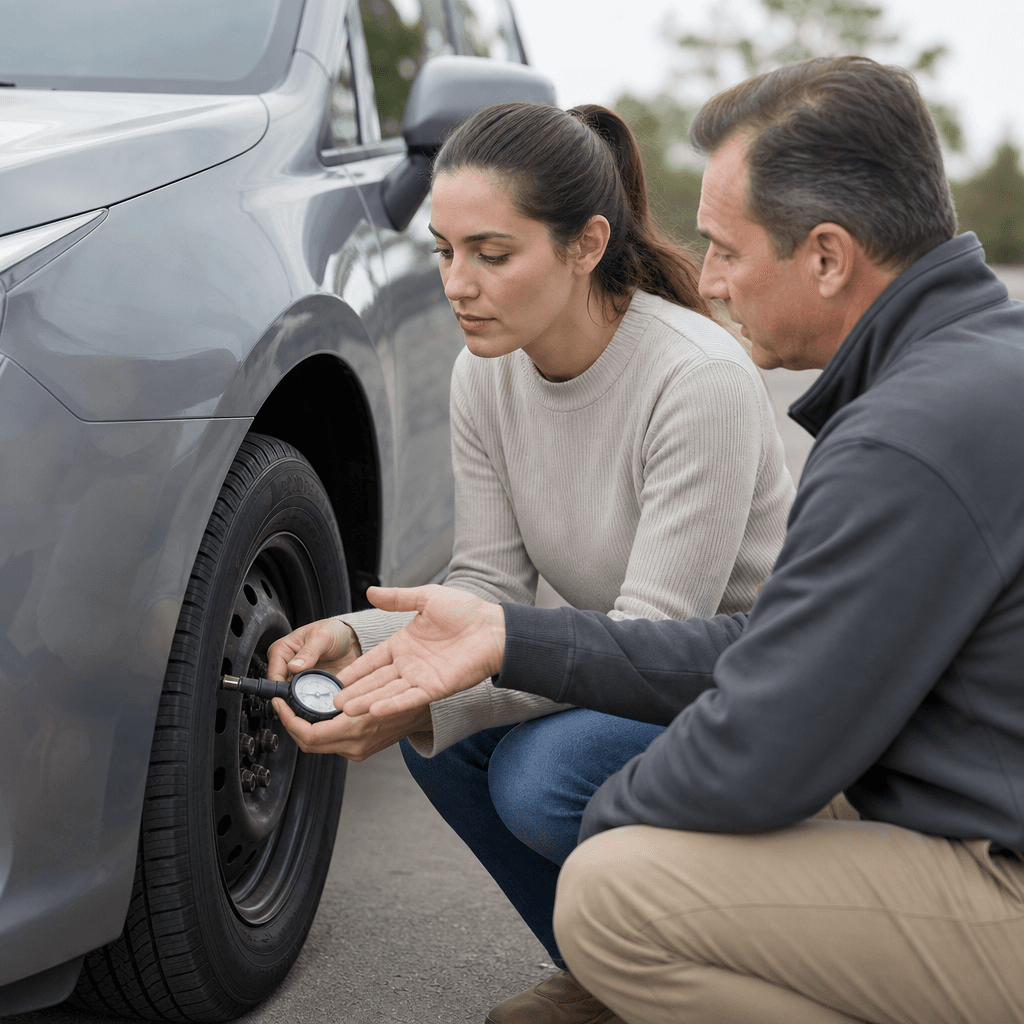
Some improvements cost nothing and can be learned in a lesson. Others involve the vehicle owner, a maintenance provider or a future purchasing decision. Separating these categories helps you act without assuming eco-driving requires a new car or expensive equipment.
Changes you can practise at no cost
- Accelerate and brake progressively when traffic allows.
- Scan ahead so you can respond before a queue or signal requires hard braking.
- Keep a safe, consistent following distance.
- Reduce unnecessary idling when safely parked.
- Combine trips and choose a sensible route.
- Remove distractions so your decisions remain smooth and timely.
Checks involving the vehicle
Correct tyre pressure, regular servicing and a reasonable vehicle load can support efficient operation. Unnecessary weight adds work for the vehicle, while poorly maintained tyres or mechanical problems can affect rolling resistance, control and fuel use.
Use the vehicle handbook for the correct tyre pressure. An instructor can help you understand the driving effect of low pressure, extra load or excessive climate-control use, but repairs, inspections and mechanical decisions belong with the vehicle owner and a qualified service provider.
Windows, air conditioning and heating affect efficiency differently depending on speed, weather and vehicle. Do not reduce climate control or open windows if that compromises visibility, alertness or safe operation. Efficient driving does not require buying an electric or hybrid vehicle or making an unsupported modification.
When safety overrides efficiency
Fuel efficiency is secondary to lawful, controlled and defensive driving. Use stronger acceleration when you need to merge safely, create space or clear a hazardous area. Leave more following distance and brake earlier on wet, snowy or icy roads, even if that uses more energy.
On a hill, maintaining control may require additional power. On a highway, joining traffic at an appropriate speed matters more than minimizing acceleration. In stop-and-go traffic, do not leave an unsafe gap or delay a necessary response simply to avoid braking.
Winter conditions also change the balance. Smooth inputs remain useful, but traction, visibility and stopping space come first. If a hazard appears, respond decisively and safely instead of trying to preserve a fuel-saving technique. The same principle applies during a road test: observation, signalling, right-of-way, speed control and safe responses matter more than achieving a particular fuel-use pattern.
Which type of lesson fits your goal?
Eco-driving can be a focused objective within broader training. Choose the main lesson type by asking what you need to do safely and consistently after the session.
- Choose beginner driving lessons if you have little or no experience. Build steering, braking, observation and speed control first, then add fuel-efficient habits as those fundamentals become reliable.
- Choose a defensive-driving focus if your priority is anticipation, space management and safer responses to other road users. Eco-driving overlaps with defensive driving through early scanning and smoother decisions, but defensive training covers the wider safety picture.
- Choose refresher instruction if you have not driven recently or feel uncertain in ordinary traffic. Rebuild control and confidence before concentrating on fuel use.
- Choose G2 or G road-test preparation if an upcoming test is your immediate goal. Efficient habits can support smooth control, but preparation must cover the skills and standards relevant to your licence stage.
- Choose an eco-driving focus if you already control the vehicle safely and want to improve anticipation, smoothness, idling choices, route planning and everyday fuel efficiency.
For a new driver, the cheapest path is not necessarily the shortest package. Individual lessons may be a sensible starting point when you need an assessment, while a multi-lesson package can suit someone with a clear goal who practises consistently between sessions. Compare lesson duration, focus, scheduling and package terms instead of choosing on price alone.
How to ask Khurana Driving School about eco-driving instruction
Khurana Driving School is based in Mississauga and offers beginner, G2 and G driving lessons, individual lessons, multi-lesson packages and a defensive-driving approach. Ask whether an eco-driving focus can be included in the lesson that matches your licence stage, experience and goal rather than assuming there is a separately named eco-driving course.
Before booking, ask:
- Can the lesson focus on smooth acceleration, anticipation, reduced idling and route planning?
- Will the instructor assess my current driving before choosing exercises?
- Is an individual lesson or package more suitable for my starting point?
- What meeting arrangement and service area apply to my location in Mississauga, Brampton or the GTA?
- Are evening or weekend lesson times available for my goal?
- What is included in the package, and what are the current terms?
Prices and mobile pickup availability are not confirmed, so ask about them directly instead of assuming a local school provides home, workplace or door-to-door pickup. If you are comparing schools or lesson formats, a broader driving-school training comparison can help you identify questions about instructor feedback, lesson structure and learner fit.
Khurana’s 24/7 support refers to enquiries, booking assistance and scheduling discussions, not 24-hour in-car instruction. Evening and weekend requests can be discussed and confirmed in advance.
Questions to ask before you book
Can a beginner learn eco-driving safely?
Yes. A beginner can learn efficient habits safely when instruction starts with basic vehicle control, observation and speed management, then adds anticipation and smoother inputs at a manageable pace. Fuel efficiency should never replace foundational driving skills.
Should I turn off the engine when stopped?
Turn it off when you are safely parked and do not need the vehicle running. Do not switch off the engine in moving traffic or where it would reduce visibility, control, climate support or your ability to respond safely.
Can eco-driving help with G2 or G road-test preparation?
Yes, as a supporting focus. Smooth control, early observation, appropriate speed and anticipation can strengthen everyday driving and test performance, but eco-driving does not replace complete G2 or G preparation.
Does eco-driving guarantee a specific fuel or emissions saving?
No. Efficient techniques can reduce unnecessary fuel use and emissions, but results vary with the vehicle, route, traffic, weather and consistency. A responsible lesson teaches controllable habits and does not promise a fixed percentage or dollar amount.
If you want to practise fuel-efficient driving as part of a safe, practical lesson plan, ask Khurana Driving School’s driving lessons about the appropriate individual lesson or package for your experience, licence goal and schedule.