
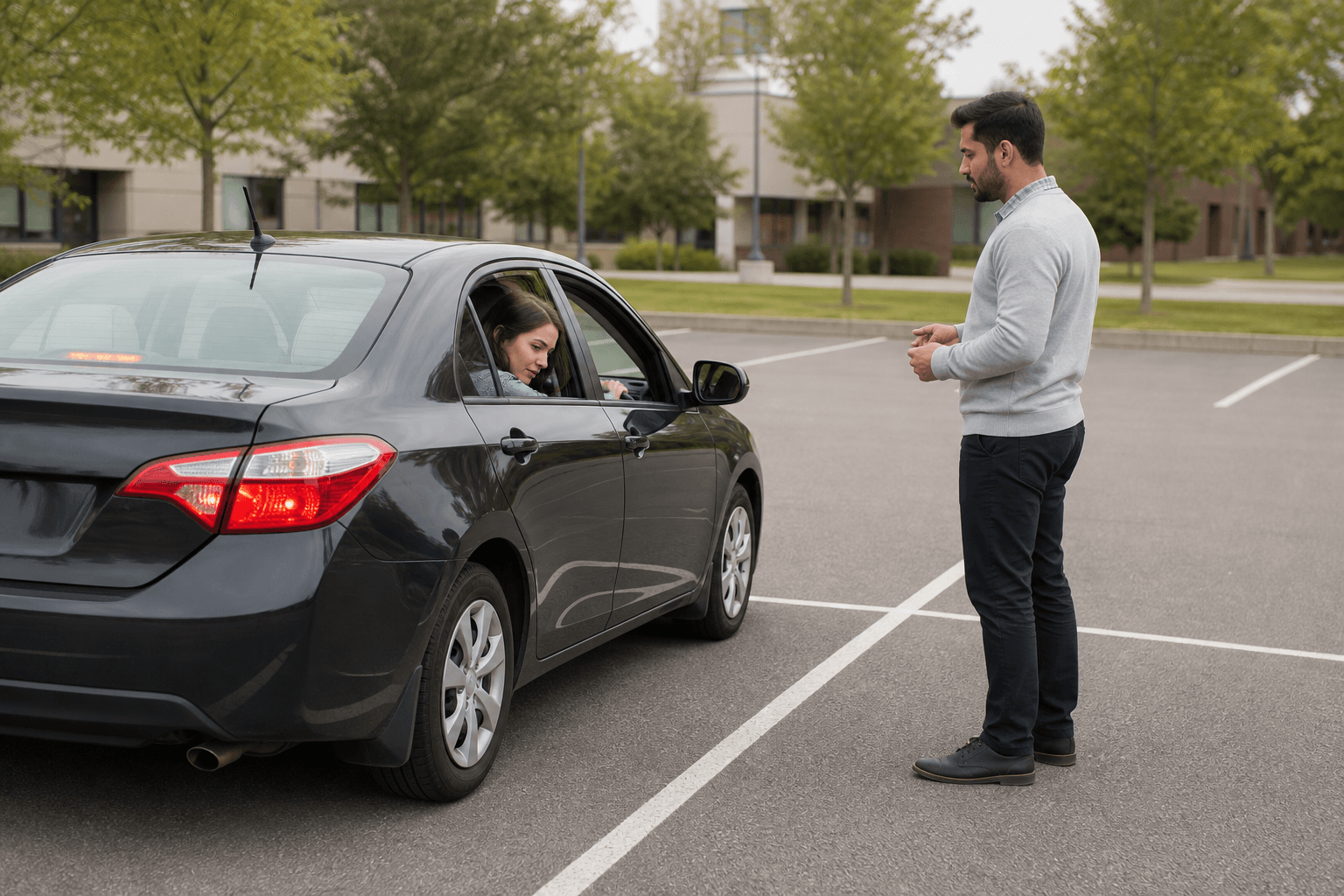
Reverse parking means backing into a marked parking stall, not parallel parking beside a curb. Start with a full observation check, position with enough space to turn into the stall, reverse slowly using adaptable reference points, straighten and centre the vehicle, and stop to reset if the angle is wrong. Ontario’s official handbook specifically requires observation around the vehicle, mirror and blind-spot checks, and reversing only when the area is clear. Related reading: Private Property Parking Enforcement in Ontario.
Reverse parking is not parallel parking
Reverse stall parking means entering a marked parking space by backing into it, usually in a parking lot. Forward parking enters the same type of stall nose-first. Parallel parking places the vehicle beside a curb between other vehicles, so its steering sequence and reference points are different.
| Manoeuvre | Where you use it | Main control challenge |
|---|---|---|
| Forward parking | A marked stall in a parking lot | Judging the front corners and leaving enough room to exit |
| Reverse stall parking | A marked stall in a parking lot or similar area | Controlling the rear corners, steering angle and final position |
| Parallel parking | A roadside space beside a curb | Backing between vehicles while staying close and parallel to the curb |
This guide focuses on reverse stall parking because it is a useful transferable skill for parking lots, daily driving and broader road-test preparation. Parking tasks and test circumstances can vary, so do not assume that reverse stall parking will appear as a standalone manoeuvre on every Ontario G2 test.
What Ontario learners should demonstrate before reversing
Before the vehicle moves, you should be able to observe the space, identify people or vehicles that could enter your path, and control the car at a walking pace. The Ontario official handbook’s Level Two Road Test guidance says drivers must look around the vehicle, check mirrors and both blind spots, and reverse only when the area is clear.
That observation habit matters beyond one parking exercise. G2 preparation can include controlled parking, turns, lane changes, observation and defensive-driving skills, so compare lessons by the full set of G2 test tasks they cover, not by parking practice alone.
Set up the vehicle before you move
A good reverse park begins before you select reverse. Choose a stall with enough room for your current skill level, then check the approach lane, the stall boundaries and the space behind and beside the vehicle.
- Choose the stall. A wider, unobstructed stall is a sensible starting point. Avoid beginning beside a pedestrian, shopping cart, vehicle turning through the lane or any object you cannot see clearly.
- Signal where appropriate. Use the signal that communicates your intention to other road users, especially in a busy parking aisle. Signalling does not give you priority over a pedestrian or moving vehicle.
- Scan before selecting reverse. Check ahead, behind, both sides, the mirrors and both blind spots. Look over your shoulder as needed so you understand the area, not just the camera image.
- Leave turning room. Position the vehicle far enough from the target stall to allow the rear of the vehicle to swing into it without crossing an adjacent vehicle or obstruction.
- Choose a slow speed. Use gentle brake control and avoid rushing the steering input. A slow vehicle gives you time to stop, reassess and correct.
Use reference points that work across vehicles
There is no single steering-wheel turn or dashboard landmark that works for every car. Vehicle length, wheelbase, steering response, stall width and the driver’s seating position all change the visual cue.
Use the parking lines and the movement of your rear corners as your main references. As the vehicle begins to angle toward the stall, watch whether both rear corners are entering with workable clearance. As the vehicle becomes more parallel with the lines, begin unwinding the steering so the wheels point in the direction of travel.
The goal is not to memorize “turn one full rotation at this exact point.” The goal is to recognize three changing conditions:
- Entry angle: the rear of the vehicle is moving toward the centre of the stall.
- Straightening point: the vehicle body is becoming parallel with the stall lines.
- Final position: the vehicle is centred between the lines with enough clearance at the front and rear.
Repeatable parking systems can replace guesswork with cues that you adjust to the vehicle you are driving.
A controlled reverse-parking method
Reverse parking is easiest to learn as a sequence of small decisions. The exact steering timing will vary by vehicle and stall, but the order below gives you a reliable framework.
- Stop in the setup position. Leave enough lateral space for the rear of the vehicle to enter the stall. Align yourself so the intended path does not point toward an occupied stall or fixed object.
- Observe again immediately before moving. Check mirrors, blind spots and the area around the vehicle. If a person or vehicle enters the path, remain stopped until the area is clear.
- Begin reversing slowly. Release the brake gradually and keep the vehicle moving at a controlled pace. Avoid adding steering before you know the rear of the vehicle is moving toward the intended stall.
- Turn toward the stall at your chosen visual cue. Use the stall line and rear-corner movement as the cue, not a fixed number of wheel turns. Keep checking the side closest to the adjacent vehicle or line.
- Monitor both sides while the vehicle angles in. Look through the rear window where visibility allows, check the mirrors and continue scanning the surrounding area. A single mirror cannot show every hazard.
- Unwind the steering as the vehicle straightens. When the body of the vehicle is becoming parallel with the stall lines, reduce the steering input. If you leave the wheels turned too long, the vehicle may finish diagonally or approach one line too closely.
- Centre the vehicle. Compare the space on both sides rather than staring at only one line. Make a small correction if needed, then stop before the rear of the vehicle reaches the end of the stall.
- Complete a final check. Before opening a door or moving out of the stall, check for pedestrians, vehicles and other hazards. When leaving, observe the aisle and surrounding spaces before selecting drive and moving forward.
For G2 preparation, parking should sit alongside observation, lane control, intersections and other manoeuvres. A structured plan that includes parking and low-speed manoeuvres helps you develop the skill without treating one successful attempt as complete readiness.
If the angle or position goes wrong, reset safely
A reset is a controlled correction, not a failure. If the vehicle is entering at a poor angle, is too close to a line or no longer gives you a clear view of the path, stop and reassess instead of forcing the manoeuvre.
| What you notice | Likely cause | Safer correction |
|---|---|---|
| The vehicle enters too sharply | The steering input began too early or was too large | Stop if the area is clear, pull forward enough to create a better approach, then recheck both sides before reversing again |
| The front is drifting toward an adjacent line | The rear path was not monitored on both sides | Stop before clearance disappears. Reposition forward instead of continuing into a tighter angle |
| The vehicle finishes close to one line | The steering was not unwound as the body straightened | Stop, assess the available space and make a small forward correction if safe |
| The vehicle stops short and remains angled | The driver straightened too early or stopped before the body aligned | Pause, check the area and continue only if the path remains clear and controlled |
| A stall line disappears from view | The camera or mirror view is being used without enough surrounding observation | Stop and regain a clear understanding of the vehicle’s position before moving |
| You are unsure whether the path is clear | Visibility is limited or the environment has changed | Remain stopped until you can observe safely. Ask for guidance during a lesson if needed |
Pulling forward to reset is acceptable during practice when the surrounding area is clear and the correction is controlled. Do not use a reset to continue moving through a hazard or to compensate for a space that no longer gives you adequate clearance.
Adapt the method to your vehicle and visibility
A compact car, SUV and longer sedan will not trace the same path through a stall. A longer wheelbase generally needs more room to change direction, while a small car may turn into the space sooner than you expect.
Adjust the driver’s seat and mirrors before practising. Use the side mirrors to judge the relationship between the vehicle and the stall lines, but remember that mirror views can change the apparent distance. A backup camera can help you monitor the rear path and confirm your position, yet it does not replace looking around the vehicle, checking mirrors and checking blind spots.
Practise the same manoeuvre in the vehicle you expect to drive regularly or use for a road test whenever possible. If you change vehicles, spend time learning its turning response and reference points again instead of transferring the previous car’s steering timing unchanged.
A three-stage practice plan
Focused practice works best when each stage has a clear target. A nervous beginner should not start with a crowded lot and a narrow stall. Build control first, then add the decisions that make the manoeuvre realistic.
Stage 1: Control the vehicle in an open area
In a clear, suitable practice area, practise reversing in a straight line, stopping smoothly and maintaining a slow pace. Use clearly marked, unobstructed stalls or another suitable practice area, and focus on looking around the vehicle rather than staring at one display.
Move on when you can reverse slowly, stop where intended and explain what you have checked before moving. You should be able to repeat the basic control task without sudden braking or rushed steering.
Stage 2: Enter wide marked stalls
Choose wide, unobstructed stalls and repeat the full sequence: setup, observation, slow reverse, steering, monitoring both sides, straightening, centring and stopping. After each attempt, identify one issue only, such as starting position, steering timing or final centring.
Do not chase a perfect first attempt. Aim for consistent observation, controlled speed and a repeatable final position across several attempts.
Stage 3: Add variety and G2 preparation
Practise from slightly different approach positions, with different stall widths and at quieter times that allow you to think clearly. Include safe resets, exits from the stall and observation of moving traffic and pedestrians.
Once reverse parking is controlled, combine it with the broader skills expected in G2 preparation, such as turns, lane changes, intersections and other parking manoeuvres. A mock-test-style session can show whether the skill remains reliable when you must manage several tasks in sequence.
When focused reverse parking lessons are worth booking
Individual instruction is useful when you repeat the same error, feel unsure about your reference points, have changed vehicles or need to prepare within a specific timeline. It can also help a nervous learner practise at a manageable pace while receiving immediate feedback instead of reinforcing an incorrect steering habit.
Before booking reverse parking lessons in Ontario, ask:
- How much of the lesson will involve active in-car coaching?
- What is the lesson duration, and how is that time divided between demonstration, guided attempts and independent repetitions?
- Can the instructor adapt the reference points to the vehicle I will use?
- How will the instructor identify whether my main issue is setup position, steering timing, observation or final centring?
- Can I practise safe resets and receive feedback on when to stop?
- How does reverse parking fit into my wider G2 test preparation?
- What are the current prices, package terms and scheduling options?
Ontario government-approved driving schools are licensed and must meet requirements for in-class and in-vehicle training, administration and advertising. Compare a provider’s approval status, then ask specific questions about the instruction you are purchasing. Khurana Driving School describes structured G2 instruction, tailored lessons, a defensive driving approach and evening or weekend options for learners in Mississauga, Brampton and the GTA.
Questions learners still ask about reverse parking
Is reverse parking required on every Ontario G2 road test?
No. The official Ontario material confirms that the Level Two road test includes parallel parking, but it does not establish reverse stall parking as a standalone manoeuvre on every G2 test. Reverse parking remains a practical skill worth learning because it improves low-speed control, observation and everyday parking ability.
Can I pull forward and reset if my reverse parking angle is wrong?
Yes, you can stop and reposition when the area is clear and the correction is safe. During practice, a controlled reset is better than forcing the vehicle through a poor angle, crossing a line or continuing without adequate visibility.
Can I use a backup camera during reverse parking practice?
Yes, a backup camera can support your view of the rear path and stall position. It cannot replace direct observation, mirror checks and blind-spot checks, and you should not rely on it to show every person, vehicle or object around the car.
How many reverse parking lessons should I book before my G2 test?
There is no reliable lesson number for every learner. Book enough focused practice to address your specific error, then judge readiness by repeated slow control, safe observation, consistent centring and the ability to correct without panic. If parking is only one of several G2 weaknesses, broader road-test preparation may be a better fit than booking parking practice alone.
Plan your next practice session
Before your next drive, write down the vehicle you will use, the stall type, your most common error and one measurable target, such as stopping centred after three controlled attempts. That information gives a driving instructor a clearer starting point and helps you choose focused practice instead of guessing at the number of lessons you need.
If you want to ask about addressing reverse parking within broader G2 preparation, contact Khurana Driving School about G2 test preparation lessons and suitable evening or weekend scheduling.