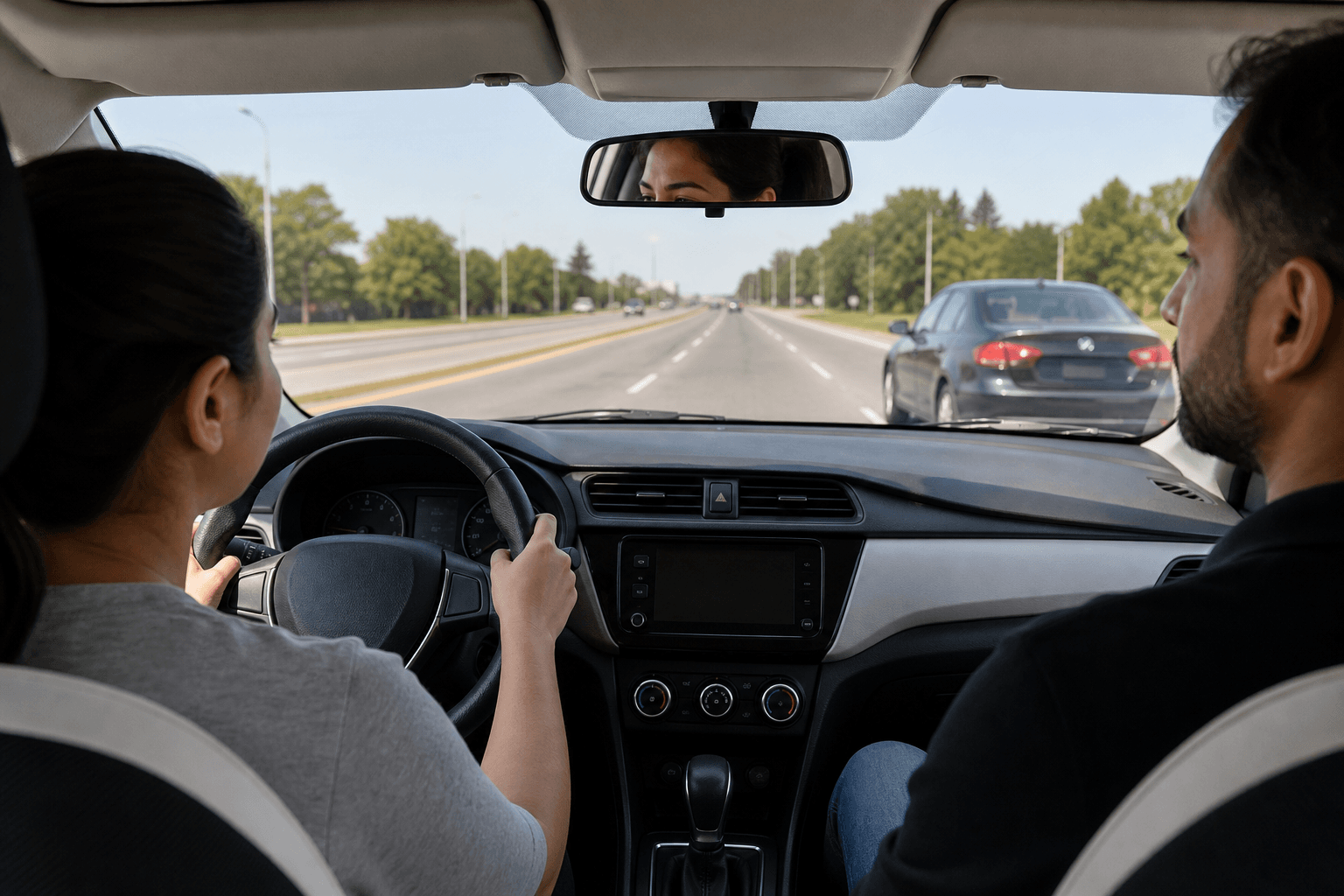

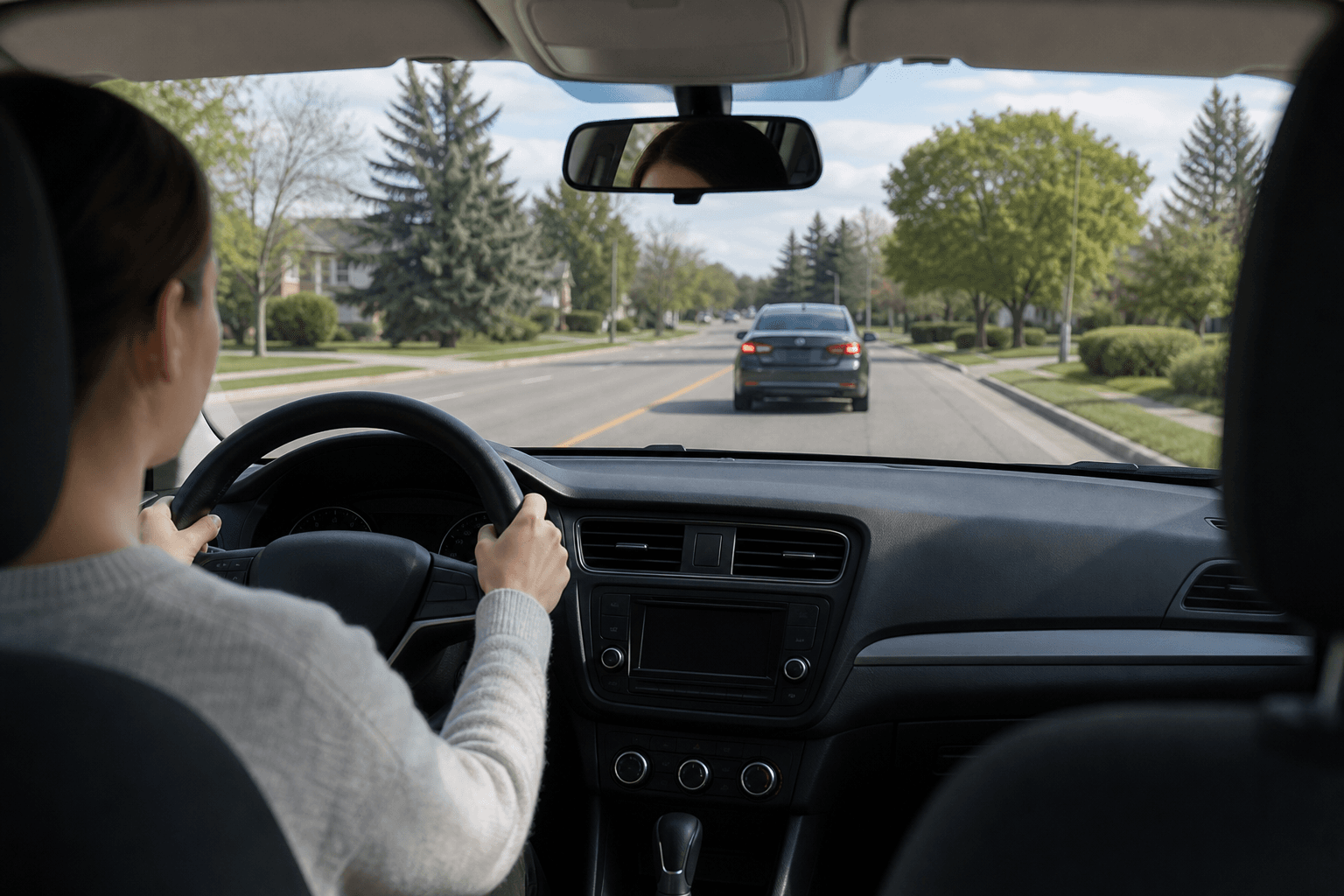
In Ontario, leave at least two seconds between your vehicle and the one ahead in good conditions. Measure the gap with a fixed roadside object, then increase it for rain, snow, ice, darkness, poor visibility, traffic, hills, curves or any situation that reduces your time to react.
Following distance is not a fixed number of car lengths or a guarantee that you can always stop. It is a space-management habit that gives you more time to see, decide and respond.
The Ontario rule: start with two seconds, then create more space
The Ontario Ministry of Transportation handbook recommends leaving at least two seconds behind the vehicle ahead. This is a baseline for suitable conditions, not a universal stopping-distance guarantee.
Following distance supports visibility, space and communication. You need to see ahead, preserve room to slow down, and communicate predictably through speed, signals and lane position. The MTO’s following-distance guidance explains the two-second method.
Increase the gap whenever the road, vehicle or traffic reduces your available reaction time. Wet pavement, darkness, fog, a heavy load, a large vehicle blocking your view or an unpredictable driver ahead all justify more space. For practical coaching on space management and hazard awareness, defensive driving lessons can turn the rule into an observed driving habit.
How to measure a two-second gap without guessing car lengths
Use a fixed object beside the road, such as a sign, light pole or large tree. When the vehicle ahead passes it, count “one thousand and one, one thousand and two.” Your vehicle should reach the same object no sooner than the end of that count.
- Choose a clear roadside reference point.
- Watch the vehicle ahead pass it.
- Count two full seconds while maintaining your lane and speed.
- Notice where your vehicle reaches the object.
- If you arrive early, ease off the accelerator smoothly and rebuild the gap.
At about 50 km/h, your vehicle travels roughly 14 metres in two seconds. At about 100 km/h, it travels roughly 28 metres. These are approximate distances, not targets to memorize. A fixed car-length rule is less dependable because vehicles differ in size and speed changes the distance travelled during the same two seconds.
When two seconds is not enough
Two seconds is a starting point for clear conditions. If visibility, traction, traffic flow or the road layout makes a sudden stop more likely, slow down as appropriate and leave a larger time gap.
| Situation | Why the basic gap may be insufficient | What to practise |
|---|---|---|
| Dry pavement and clear daylight | The baseline is easiest to judge. | Measure the gap and scan beyond the vehicle ahead. |
| Rain or standing water | Wet surfaces reduce grip and spray can hide hazards. | Reduce speed when needed and avoid sudden inputs. |
| Snow or slush | Traction and stopping control can change quickly. | Increase space substantially and use smooth controls. |
| Ice or freeze-thaw conditions | Available grip may be much lower than the road appears. | Slow before the hazard and leave generous room. |
| Darkness | Stopped vehicles and hazards may be detected later. | Drive only as fast as visibility allows and preserve extra space. |
| Fog, spray or reduced visibility | You have less time to identify what is ahead. | Increase space and reduce speed. |
| Hills and curves | The road may hide slowing traffic or hazards. | Ease off before the crest or curve. |
| Heavy traffic | Braking and merging can collapse the cushion. | Look several vehicles ahead and avoid accelerating into every opening. |
| Stop-and-go traffic | Small speed changes can become hard braking. | Lift off early and roll to controlled stops. |
| Changing surfaces | Gravel, paint, construction areas and uneven pavement affect control. | Adjust speed before the change and create more room. |
There is no single correct number of extra seconds for every condition. Ask whether you can see far enough ahead, whether your tyres have dependable grip and whether you have room to respond without harsh braking.
At higher speeds, keep your eyes moving ahead, to the sides and behind. The MTO handbook recommends looking 15 to 20 seconds ahead, or as far as possible, when travelling faster. Freeway-scanning guidance connects following distance with what is happening farther down the road.
Following distance is part of a space cushion
A safe space cushion includes the area in front, behind and beside your vehicle. Avoid sitting beside another vehicle unnecessarily, monitor traffic behind you and leave room to respond. Ontario’s safe-driving guidance recommends maintaining space around the vehicle.
Following distance, stopping distance and following too closely are different
Following distance is the gap between your vehicle and the one ahead. Stopping distance includes the distance needed to notice a hazard, react and stop. It changes with speed, alertness, road surface, tyres, brakes, vehicle load and slope.
The two-second method preserves time but does not calculate your exact stopping distance. Following too closely is also a separate road-safety and legal concern. Ontario advises maintaining adequate distance, allowing safe merges and minimizing unnecessary lane changes. A timing exercise is not legal protection.
Large vehicles, ramps and intersections
Leave extra room behind a truck or bus because it can block your view of traffic, signs and brake lights. If it creates spray or carries a load, increase the gap further.
Near a freeway entrance, exit ramp or busy intersection, expect speed changes and vehicles entering your path. Scan beyond the nearest vehicle, control your speed and avoid accelerating into a narrowing gap.
What to do when traffic changes your gap
The safest response is usually an early, smooth speed adjustment. Do not defend your space with sudden acceleration, aggressive braking or an unnecessary lane change.
Another vehicle cuts into the gap
Lift off the accelerator and rebuild your following distance behind the vehicle that moved in. Avoid braking sharply unless necessary. Your task is to create time again, not regain your original position.
Ontario’s safe-driving advice supports allowing other drivers to merge or change lanes when it is safe.
A driver is tailgating you
Do not brake suddenly or speed beyond a safe speed. Look farther ahead, increase the space in front of you and change lanes when safe and lawful if that lets the other driver pass.
You are behind a snowplow or large vehicle
Increase the gap and avoid driving beside a snowplow in poor conditions. Spray, snow clouds and limited visibility can hide lane markings and hazards. Pass only when visibility, space and road conditions allow it safely and lawfully.
Traffic is moving in waves
Look beyond the vehicle immediately ahead and anticipate slowdowns. Ease off early instead of accelerating hard and braking hard. A steady gap may invite a merge, but it gives you more room to roll smoothly.
You are approaching a hill or curve
Ease off before the crest or bend. Do not follow at a speed that requires brake lights to reveal a hazard you cannot yet see.
How following distance appears in G2 and G road-test preparation
An examiner can observe whether you scan ahead, respond early to traffic changes, maintain controlled speed, brake smoothly and preserve space while changing lanes or merging.
There is no single habit that guarantees a pass. Observation, right of way, speed control, lane position, signalling, manoeuvres and space management can all affect performance. The MTO handbook identifies following too closely, speeding, failing to yield, improper turns, red-light violations and frequent lane changes among collision-related behaviours.
- Scan: Look beyond the nearest vehicle and check mirrors before changing speed or position.
- Space: Keep a visible time gap and rebuild it after a merge or slowdown.
- Speed: Match speed to visibility, traffic, road design and traction.
- Braking: Lift off early and brake progressively.
- Merging: Check the gap, signal, match speed and avoid forcing another driver to brake.
- Hazard anticipation: Notice brake lights, blocked sightlines, pedestrians, turning vehicles and changing surfaces early.
If you are preparing for a G2 or G test, G2 driving lessons can place following distance alongside highway experience, merging, lane changes and observation.
A supervised practice exercise for correcting your gap
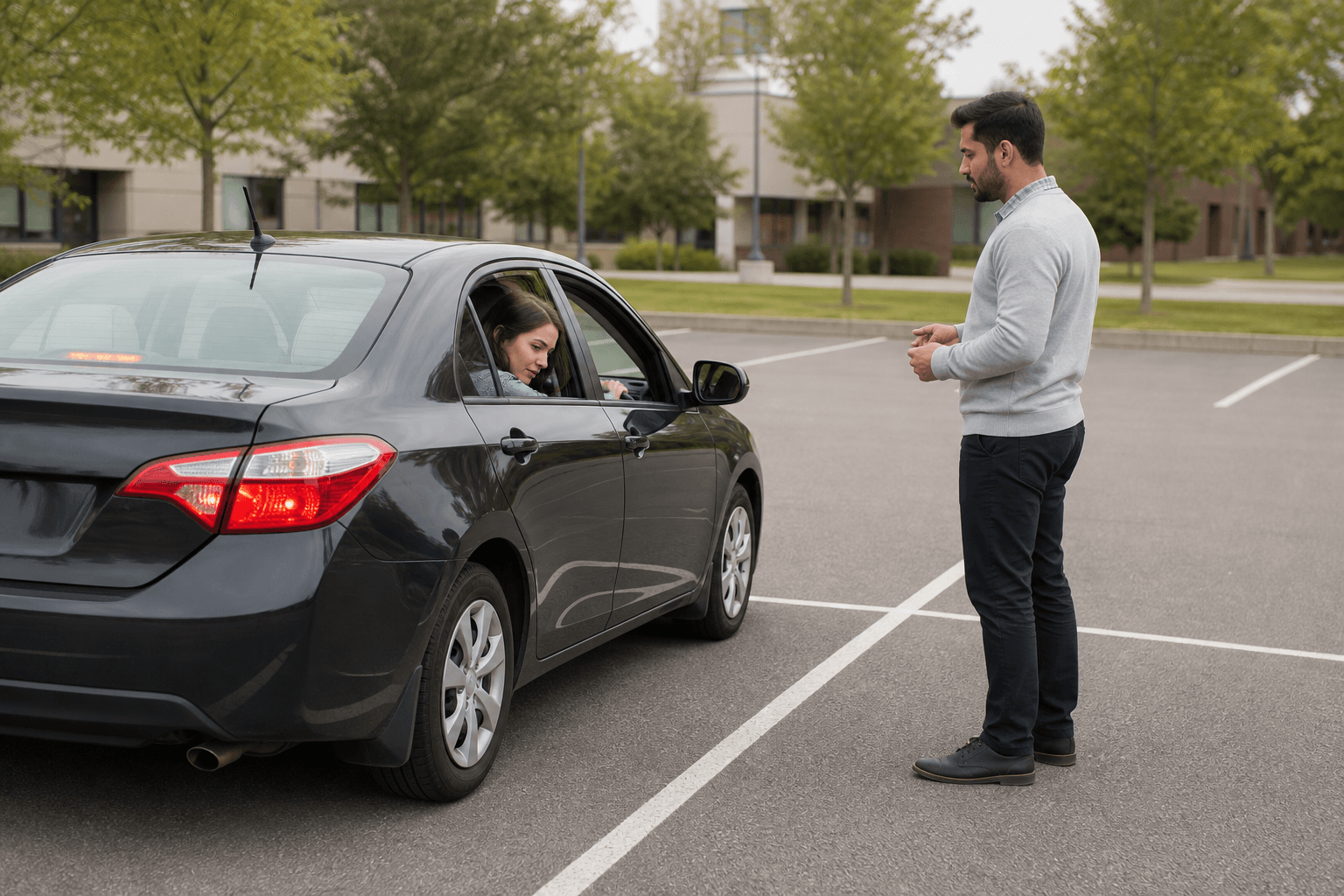
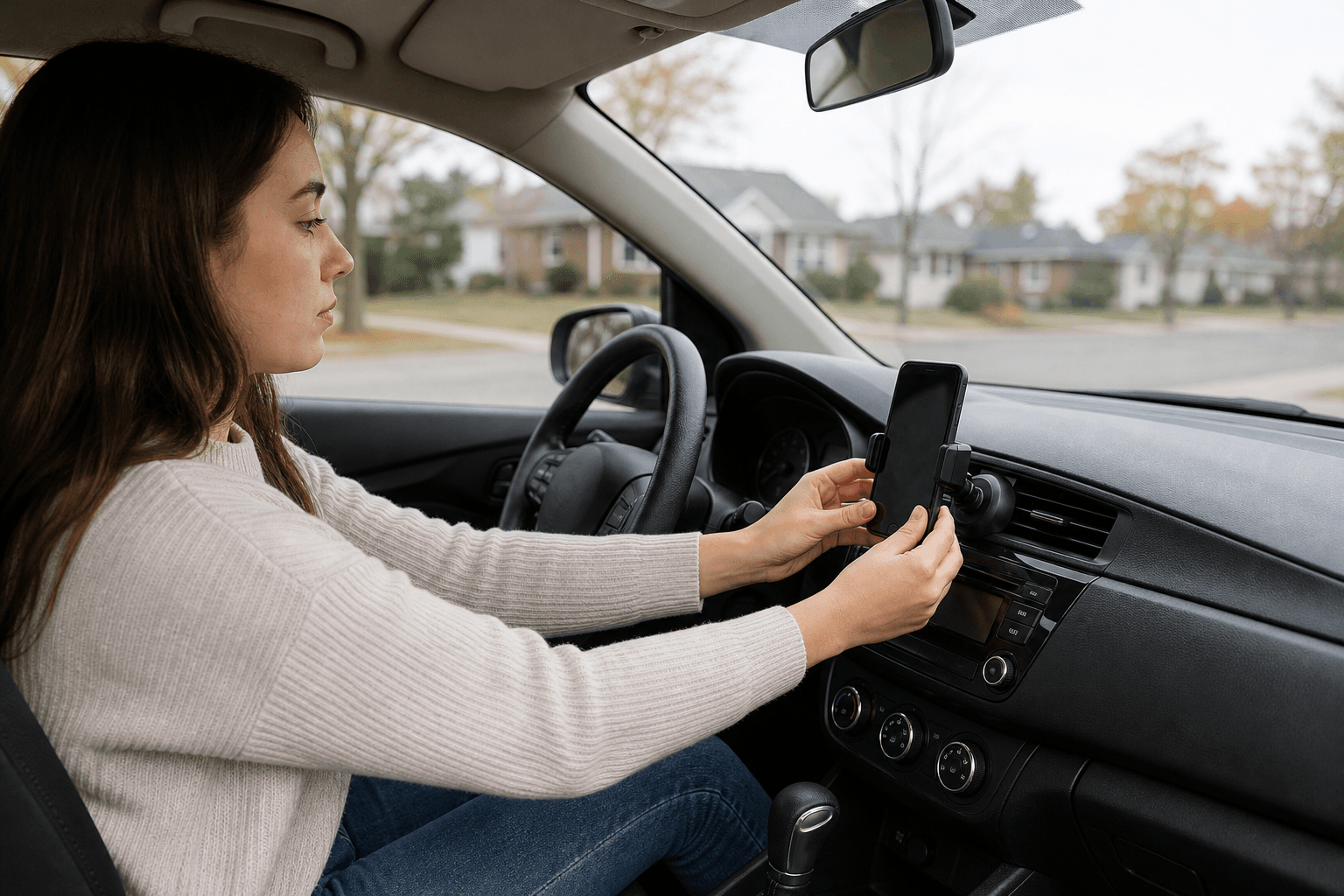
Practise with a qualified supervising driver or instructor on a familiar, low-risk route. Do not use a phone, write notes or stare at the roadside object while moving.
- Start in clear daylight on a road with steady traffic and good visibility.
- Choose one moderate-speed goal.
- Use a sign or pole to count a two-second gap.
- Repeat after a speed change and notice how the physical distance changes.
- After a safe cut-in, lift off smoothly and rebuild space.
- Review whether you closed the gap during conversation, curves, hills or traffic waves.
- Add rain, darkness, highway speeds or heavier traffic only after the basic habit is consistent.
Useful feedback is specific: “You reached the object before two seconds,” “Your gap disappeared when traffic slowed,” or “You braked late because you were watching only the nearest vehicle.”
Choose instruction that matches your following-distance goal
The best lessons for a nervous beginner are individual and progressive, beginning with vehicle control and building toward traffic judgement. Choose focused defensive-driving practice if you close the gap, brake late or feel pressured by traffic behind you. Choose G2 or G preparation if you also need highway practice, merging, lane changes and test-focused feedback.
Khurana Driving School offers individual lessons, a defensive-driving approach, G2 and G road-test training, and evening and weekend lessons. Related reading: Driving school trans canada st laurent.
For broader context on visibility, space, communication and hazard anticipation, explore defensive driving training before choosing your coaching goal.
Questions Ontario learners still ask
Is the two-second rule a legal guarantee?
No. It is minimum handbook guidance for suitable conditions, not a guarantee of safe stopping. Increase the gap when traction, visibility, traffic or road layout reduces response time.
Is following distance the same as stopping distance?
No. Following distance is the gap you maintain. Stopping distance includes noticing, reacting and stopping, so it changes with speed, traction, vehicle condition, alertness and road grade.
What should I do after a cut-in?
Ease off the accelerator and create a new gap. Avoid sudden braking or trying to prevent every merge.
How should I respond to tailgating?
Drive predictably, increase the space ahead and change lanes safely if that allows the other driver to pass. Do not brake suddenly to make a point.
Does following distance affect G2 or G performance?
Yes. It connects with scanning, speed management, smooth braking, merging and hazard response. Practise the complete behaviour instead of watching only the gap.
What are the “5 Fs” of driving?
“The 5 Fs” is not needed to apply Ontario’s two-second method and is not used here as an official test standard. Focus on the current MTO handbook, visible space, early observation, controlled speed and predictable communication.
What hand position should I use?
Hand position is a separate steering-control skill. Learn the position and steering technique your instructor teaches for your vehicle and the manoeuvre while continuing to prioritize observation and lane control.
Turn following distance into your next lesson goal
If you repeatedly close the gap, brake late or feel overwhelmed when traffic changes, bring one specific example to your next lesson. Ask for coaching on measuring the gap, adjusting for conditions and rebuilding space after a cut-in, then match that practice to your licence stage.
Khurana Driving School serves learners in Mississauga, Brampton and the GTA. To discuss available defensive-driving or road-test services, visit defensive driving and road-test services.