

If you are searching for a G1 theory study plan, you are likely preparing for Ontario’s G1 knowledge test. The most reliable approach is to use the Official MTO Driver’s Handbook as your main source, divide the material into topics, practise active recall, and use sample questions to find gaps rather than relying on random memorization.
Ontario’s graduated licensing process begins with a vision test and a knowledge test for eligible new drivers. The province commonly refers to this as the G1 knowledge test, although many learners call it the G1 theory test.
Quick summary

- Use the Official MTO Driver’s Handbook as your foundation, not practice questions alone.
- Study by topic over seven days, covering signs, rules of the road, safe driving, sharing the road, and freeway situations.
- Keep an error log showing what you missed, why you missed it, and where the correct rule appears in the handbook.
- Before attending, confirm current appointment details and bring the required identification, payment, and vision-related eyewear if needed.
What to Study for Ontario’s G1 Knowledge Test
Your study plan should cover the main areas identified in Ontario’s official material, including traffic signs and lights, seatbelts, emergency vehicles, speed limits, freeway entry and exit, passing, collision reporting, and sharing the road. The handbook also addresses practical rules and situations that require you to choose the safest or legally correct response.
Start by reviewing the MTO licence steps if you are new to Ontario. Then use the handbook to guide your study of Ontario road rules and the knowledge-test material. Avoid building your plan around an unverified question count, passing score, or time limit, since those details should be confirmed through current official information.
Do not treat the G1 knowledge test as a substitute for driving instruction. It checks your understanding of rules and safe decisions, while later G2 or G road-test preparation requires supervised in-car practice.
A Seven-Day G1 Study Plan
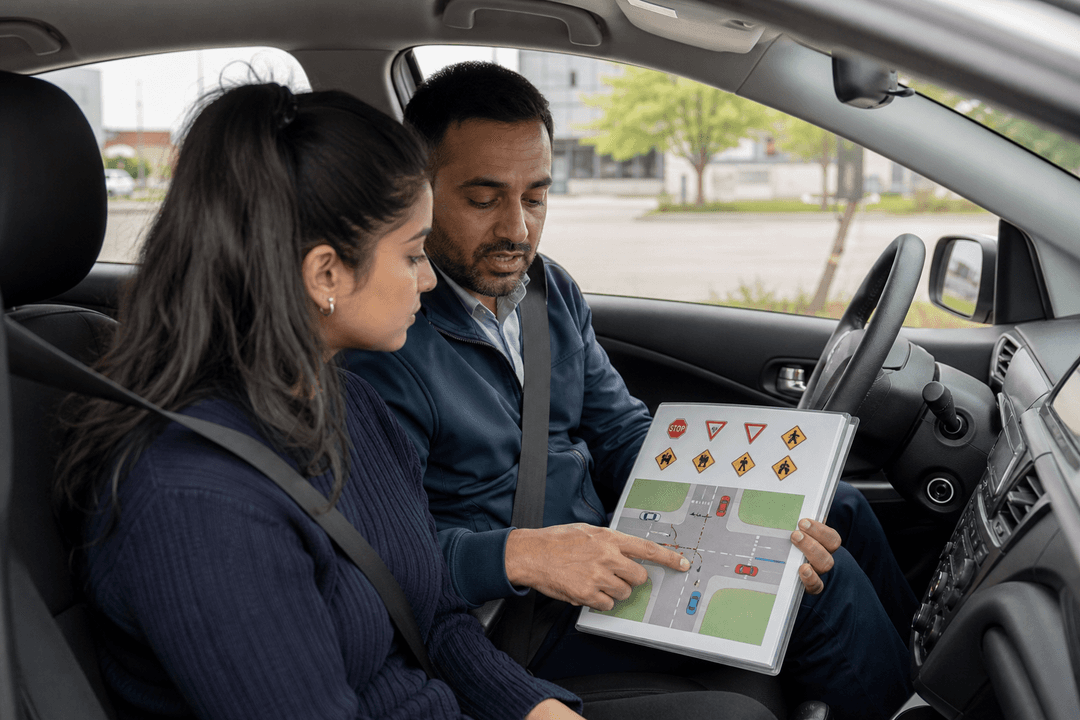
Set aside a consistent study period each day. A useful session includes three parts: read a focused section of the handbook, close it and explain what you remember, then complete a short set of practice questions or write your own examples.
Day 1: Set Up Your Study System and Learn the Test Scope
Gather the current Official MTO Driver’s Handbook, a notebook or digital document, and a source of official sample questions. Create an error log with columns for the topic, your answer, the correct rule, the handbook section, and the date you will review it again.
Begin with a short diagnostic set of sample questions. Do not use the result as a prediction of your test performance. Its purpose is to show whether you need to spend more time on signs, right-of-way, safe driving, or another topic. Ontario provides sample multiple-choice questions for self-assessment in the handbook.
Day 2: Traffic Signs, Signals and Road Markings
Study signs, traffic lights, pavement markings, and the action each one requires. Instead of reading the same page repeatedly, cover the explanation and try to identify each sign from memory. For every confusing sign, write three details: what it looks like, what it communicates, and what a driver should do.
Finish by reviewing your list without looking at the answers. If two signs seem similar, write a short comparison in your own words. This makes the distinction easier to retrieve when a question presents the signs in a different order or context.
Day 3: Rules of the Road and Right-of-Way
Focus on intersections, lane changes, passing, speed-related rules, and situations where one road user must yield to another. For each rule, create a simple scenario. For example, describe where each vehicle is positioned, who arrives first, and what the safest legal action should be.
Right-of-way is easier to remember when you understand the decision rather than memorizing a sentence. The handbook explains rules such as what to do when vehicles reach an uncontrolled intersection at the same time, along with other rules of the road that may appear in knowledge-test questions.
Day 4: Safe Driving and Sharing the Road
Review seatbelts, emergency vehicles, vulnerable road users, collision reporting, and defensive choices. Ask yourself what a driver should notice first, what risk is developing, and which action reduces that risk.
Use realistic examples, but return to the handbook whenever your personal experience conflicts with the written rule. A story from another driver, a social-media post, or an unofficial practice app should not replace Ontario’s official material.
Day 5: Freeway Driving and Higher-Risk Situations
Study freeway entry and exit, maintaining safe speed and spacing, passing, night driving, and other higher-risk situations covered in the handbook. Ontario’s official guidance notes that new drivers should build experience at lower speeds and may only drive on freeways with a licensed instructor while holding a G1 licence.
Make a short “decision card” for each situation. Include what to check, what to avoid, and what action should come next. This is more useful than highlighting every sentence because it forces you to turn information into a driving decision.
Day 6: Practice Questions and Targeted Review
Use the official sample questions as a diagnostic tool. For every missed answer, identify the reason: you did not know the rule, misunderstood the wording, confused two signs, or guessed correctly without understanding why.
Reread the relevant handbook section, write the rule in plain language, and create a new example. Return to the same topic later rather than reviewing it immediately once and moving on. A correct answer that depended on a guess also belongs in your error log.
Day 7: Consolidate, Recheck and Stop Cramming
Review your error log from beginning to end. Test yourself on the rules you missed most often, explain commonly confused signs without notes, and complete another short set of practice questions from the official material.
Use the final evening for light review rather than random last-minute memorization. Prepare your documents, check the appointment information, and get enough rest to read questions carefully. A calm review is more useful than trying to learn every remaining detail in one sitting.
How to Use an Error Log Effectively
A simple error log can turn practice into a personalized study plan. Use this format:
| Column | What to record |
|---|---|
| Topic | Signs, intersections, freeway driving, or another subject |
| Your answer | What you selected or believed |
| Correct rule | The rule rewritten in clear, everyday language |
| Handbook location | The chapter or section where you can verify it |
| Follow-up date | When you will test yourself on it again |
Group repeated mistakes together. If several errors involve intersections, spend your next review session on intersection rules instead of restarting the entire handbook. This keeps your preparation efficient while still allowing you to revisit all major topics.
G1 Knowledge Test Readiness Checklist
You do not need to know every answer by vague familiarity. You should be able to explain the rules that previously caused problems and distinguish signs or situations that you often confuse.
- You have studied the relevant handbook sections rather than relying only on practice questions.
- You can explain your weakest rules without looking at your notes.
- You have reviewed signs, traffic lights, right-of-way, safe driving, freeway situations, and sharing the road.
- Your error log shows that you are correcting recurring mistakes instead of repeating them.
- You know where to verify any rule that still seems unclear.
Verify Appointment Details Before You Go
Check current Ontario or DriveTest information for the location, appointment process, fees, and any requirements that may have changed. The supplied evidence does not establish current fee amounts, appointment availability, question allocation, or test timing, so do not rely on an old post or an unofficial app for those details.
Ontario’s handbook indicates that applicants should bring two pieces of identification, payment for test fees, and glasses or contact lenses if they need them to drive. Confirm the accepted identification and payment details before leaving, particularly if this is your first visit.
When Independent Study Is Not Enough
Independent study may be enough when you can understand the handbook, organise your own schedule, and correct mistakes through review. Additional help may be useful if you are unfamiliar with Ontario road rules, find the wording difficult to interpret, feel nervous about studying alone, or keep missing the same topic despite rereading it.
In that situation, ask about a structured beginner plan, theory classes, or Ontario road-rule orientation. Before booking, confirm what the instruction includes, how lessons are delivered, the schedule, the price, and whether the support is designed for your starting point. Do not assume that every driving school offers the same theory format.
Khurana Driving School offers theory classes, individualized instruction, defensive driving training, G2 and G preparation, lesson packages, and evening and weekend lessons. If you need support beyond solo study, compare a structured beginner plan with theory classes and Ontario road-rule orientation, then ask how the instructor would identify and address your weak areas.
How G1 Theory Preparation Connects to Later Driving Lessons
G1 preparation and in-car instruction serve different purposes. The knowledge test assesses your understanding of Ontario rules, signs, and safe driving decisions. G2 and G road-test preparation requires practical skills such as observation, steering, lane changes, parking, speed control, and responding safely in traffic.
Strong theory knowledge gives you a useful foundation for later lessons because you can recognise signs, understand right-of-way, and discuss defensive choices with an instructor. However, passing the knowledge test does not replace supervised driving practice or guarantee readiness for a road test.
Frequently Asked Questions
Is the G1 theory test the same as Ontario’s G1 knowledge test?
Yes, “G1 theory test” is common informal wording for Ontario’s G1 knowledge test. When searching for official information, use terms such as “G1 knowledge test,” “Official MTO Driver’s Handbook,” and “graduated licensing.”
Should I study the handbook or use practice questions first?
Start with the handbook, then use practice questions to check your understanding. Questions are useful for finding gaps, but they should not be your only study source because memorizing an answer does not necessarily mean you understand the rule.
How do I know when I am ready to take the G1 knowledge test?
You are in a stronger position when you can explain your weak topics without notes, recognise commonly confused signs, and use practice questions to confirm improvement. Also verify the current appointment and test-day requirements rather than assuming that an older guide is still accurate.
Can driving theory classes help if I am new to Ontario’s road rules?
They can provide structure and clarification when the handbook feels unfamiliar or difficult to organise. Ask the provider to explain the planned topics, format, timing, and cost, and to identify how the instruction will address your specific knowledge gaps.
Conclusion: Follow the Plan, Then Verify the Details
A practical G1 theory study plan starts with the Official MTO Driver’s Handbook, not a collection of unsourced shortcuts. Study by topic over seven days, practise recalling rules without notes, use official sample questions diagnostically, and keep an error log that directs your next review.
Before your appointment, confirm current details through official Ontario or DriveTest information and prepare your identification, payment, and required eyewear. If independent preparation is not working, structured theory support can help you build an organised understanding of Ontario road rules before moving on to in-car training.
Learners in Mississauga, Brampton, and the GTA can discuss theory classes, beginner instruction, and their starting point with Khurana Driving School.