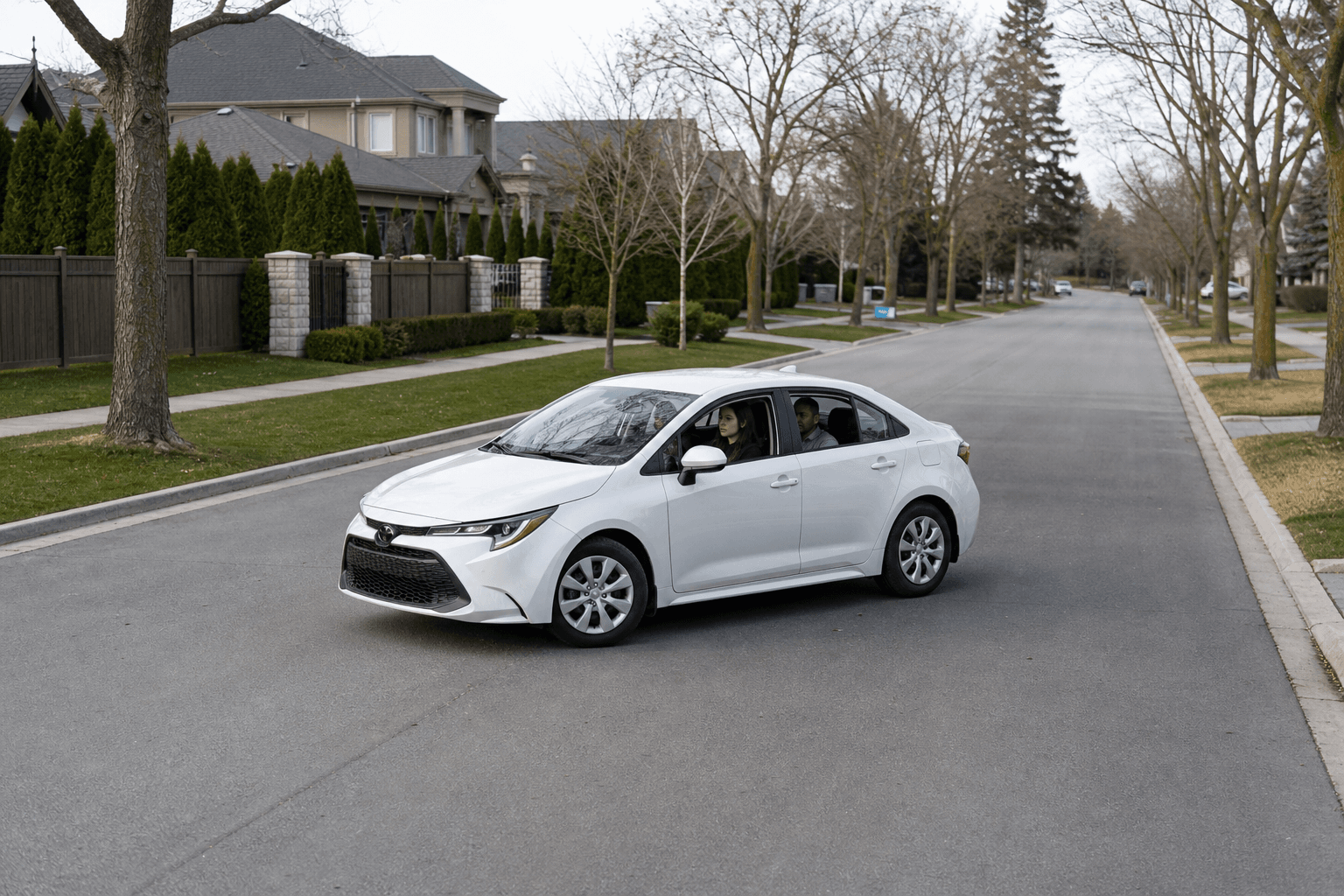

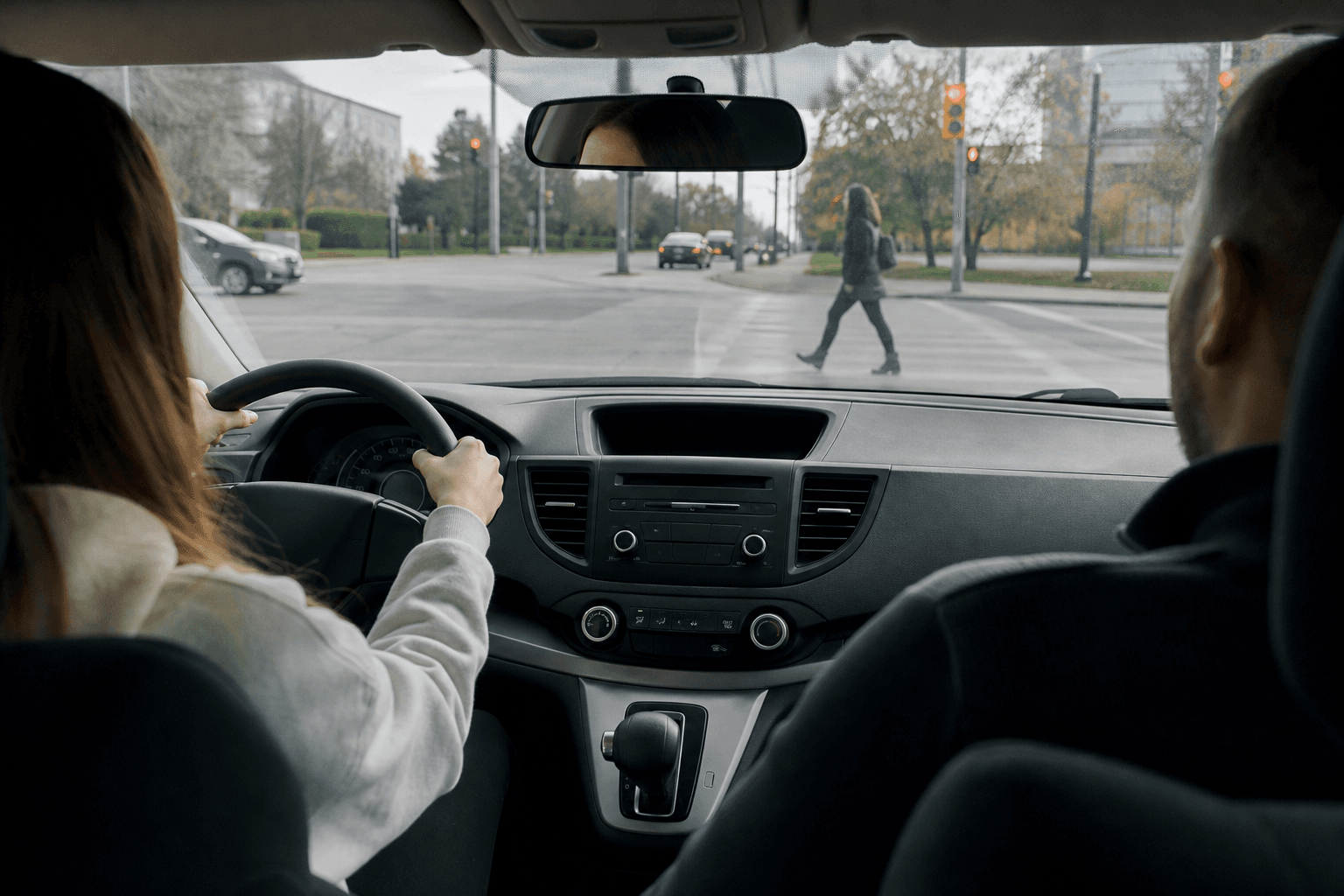
In Ontario, who goes first depends on signs, traffic lights, crossing users, arrival order, vehicle position and whether a driver is turning or entering another roadway. At an uncontrolled intersection, if two vehicles arrive from different roads at the same time, the driver on the left yields to the driver on the right. Even when you have priority, proceed only when the way is safe and never insist on right of way if another road user is acting incorrectly.
“Right of way” means the traffic rule that determines who should proceed first. It does not give you permission to drive into a conflict. The examples below are designed for Ontario learners studying the G1 rules, practising for a G2 test or building safer everyday driving habits.
The five-question method for deciding who goes first
When the answer is not immediately obvious, use the same sequence every time. This prevents you from relying on assumptions such as “the larger road always goes first” or “the vehicle on my right always has priority.”
- What controls the intersection? Look for traffic lights, stop signs, yield signs, lane arrows, pedestrian signals or a roundabout.
- Who is crossing or approaching? Scan for pedestrians, cyclists, motorcycles, buses, streetcars and emergency vehicles.
- What is each vehicle doing? Identify vehicles going straight, turning left, turning right, changing lanes, merging or entering from a driveway or side road.
- Who arrived first, and where? At a stop-controlled intersection, arrival order matters. At an uncontrolled intersection, simultaneous arrival and left-right position matter.
- Is the movement actually safe? If another driver is moving incorrectly, wait, brake or create space. A legal priority is never a reason to cause a collision.
This process reflects defensive driving in Ontario: use visibility, space and communication to anticipate hazards and make your actions predictable. You can apply those principles through defensive driving in Ontario.
Four-way stops and two-way stops: the order changes with the signs
A four-way stop requires every approaching vehicle to stop. A two-way stop requires only traffic facing the stop signs to stop, so a vehicle on the uncontrolled road may proceed before a stopped vehicle if the path is clear and the movement is safe.
| Situation | Who yields? | Safe action |
|---|---|---|
| One vehicle arrives first at a four-way stop | Later arrivals yield to the vehicle that stopped first. | Stop completely, check again, then proceed when clear. |
| Two vehicles arrive together at a four-way stop | The driver on the left yields to the driver on the right. | Make the order clear, then move smoothly without racing. |
| Vehicles arrive together and one is turning left | The left-turning driver yields to the opposing vehicle going straight or turning right. | Wait for the opposing vehicle to clear. |
| A stopped vehicle faces a two-way stop | It yields to traffic on the uncontrolled road. | Stop fully and wait for a safe gap in both directions. |
| Several vehicles arrive at once | Use arrival order, left-right position and turning movement together. | Proceed one vehicle at a time. If unclear, wait. |
Example: different arrival times
Vehicle A stops at a four-way stop. Vehicle B reaches the intersection later. Vehicle A proceeds first, even if Vehicle B is travelling straight and Vehicle A is turning, provided the path is clear.
Example: simultaneous arrival
       Vehicle B
           ↓
Vehicle A → + ← Vehicle C
           ↑
       Vehicle D
If Vehicles A and C arrive at the same time from opposite directions, a vehicle going straight generally proceeds before a vehicle turning left. If both have the same movement, the vehicle on the left yields to the vehicle on the right. Do not use speed to decide the order.
At a two-way stop, do not assume that stopping gives you priority over traffic that does not face a stop sign. Wait for vehicles already travelling along the uncontrolled roadway, then check again for pedestrians and cyclists.
Uncontrolled intersections: the vehicle on the left yields
At an uncontrolled intersection in Ontario, two vehicles approaching from different roads at the same time create a right-side priority rule. The driver on the left yields to the driver on the right. Review the official intersection guidance for the current provincial wording.
Example: Vehicle A is on the left
Vehicle A →       +       ← Vehicle B
                 ↑
          Vehicle B is on A's right
If Vehicle A and Vehicle B arrive at the same time, Vehicle A yields. Vehicle B may proceed first if it has a clear path. Vehicle A should remain stopped until the conflict is resolved, then scan again.
What if one vehicle is already in the intersection?
A vehicle already in the intersection has begun its movement and should be allowed to clear. Do not enter simply because you believe you have priority. Reduce speed early, leave space and avoid blocking the intersection.
What if arrival timing is unclear?
Do not guess or accelerate to claim the space. Brake or remain stopped, make your intention clear through your position and signal where appropriate, and proceed only after the other driver’s movement is clear.
Traffic lights, yield signs and flashing signals
A traffic light or sign controls the decision before general intersection rules do. A green light permits movement only after you check for pedestrians, cyclists and vehicles still clearing the intersection.
- Green light: Proceed only if the intersection and intended path are clear.
- Yellow light: Stop if you can do so safely.
- Red light: Stop at the required position and wait.
- Flashing red: Treat it as a stop control.
- Flashing yellow: Slow down, scan carefully and proceed with caution.
- Yield sign: Reduce speed and give priority to traffic and crossing users whose paths conflict with yours. Stop if necessary.
For extra sign practice, use this Ontario road signs guide.
Turning examples: left turns, right turns and crossing paths
Turning changes the order because your vehicle may cross another road user’s path. A left-turning driver generally waits for oncoming traffic going straight or turning right, as well as pedestrians and cyclists crossing the intended path. A right-turning driver must check the crosswalk, sidewalk, bike lane, adjacent lane and the space beside the vehicle.
Left turn across oncoming traffic
Vehicle A faces a green light and wants to turn left. Vehicle B approaches from the opposite direction and is going straight. Vehicle A waits for Vehicle B to pass unless a protected left-turn signal or other control permits the turn.
Vehicle A  ↰        +        ↗ Vehicle B
        left turn          straight ahead
The same principle applies when Vehicle B is turning right and the paths conflict. Confirm the gap and check for people crossing.
Right turn across a crossing
Before turning right, check the mirror, signal, crosswalk, sidewalk, bike lane and the lane you are entering. Slow enough to complete the observation before committing to the turn.
Two vehicles turning at the same time
If opposing vehicles are both turning left at a suitable controlled intersection, they can often turn at the same time by following their proper paths, but only when the markings, space and traffic control make the movements safe. If a path is unclear, wait.
These decisions are useful targets for in-car G2 test preparation. Practise observation, signalling, position, speed, yielding and controlled turns. A signal communicates your intention, but it does not give you priority.
Lane changes, merging and entering a roadway
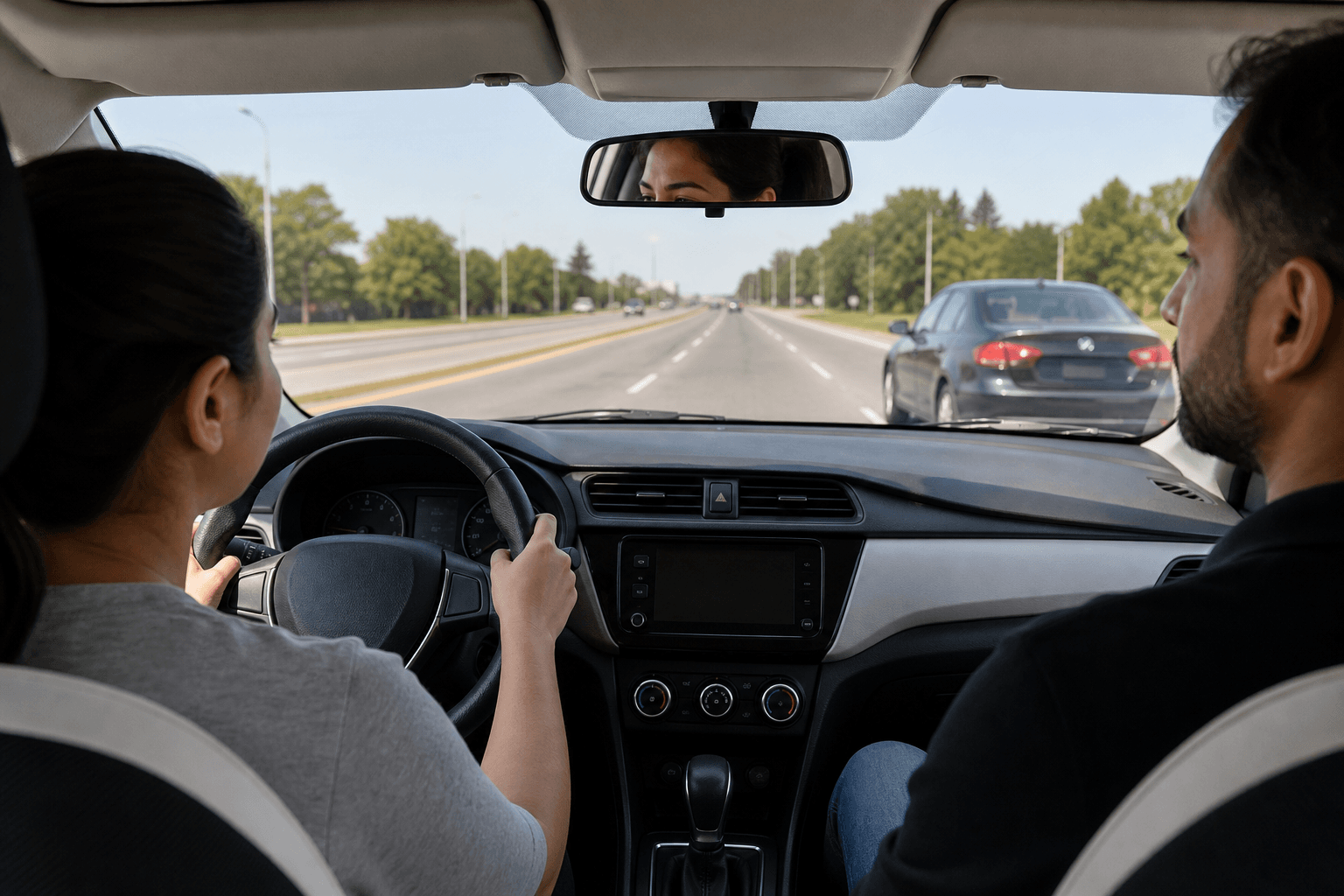
The driver changing lanes, merging or entering a roadway must yield to traffic already occupying the lane or roadway when the paths conflict. The vehicle already in the lane does not have to create a gap.
- Check mirrors.
- Signal early enough to communicate your movement.
- Check the blind spot immediately before moving.
- Select a gap that leaves room in front and behind.
- Adjust speed smoothly and move only when the lane is clear.
- Cancel the signal and settle into the lane without cutting off another road user.
Entering from a driveway, parking lot or private road requires the same care. Scan the sidewalk and roadway, and yield to people and traffic already using the public way.
Pedestrians, cyclists, school crossings and transit vehicles
Crossing users can change the decision even when your traffic signal is green or another vehicle appears to have priority. The correct response depends on the signal, crossing control, road markings, the person’s position and whether your movement would create a conflict.
- Pedestrian crossover or crosswalk: Slow down before the crossing, scan the full width of the road and stop when a pedestrian is crossing or entering the path you must travel. Remain stopped until the person has cleared your lane and the adjacent lanes that create a conflict. Never pass a vehicle stopped for a pedestrian.
- Cyclists: Check beside and behind you before turning or crossing a bike lane. Yield when your turn would cross the cyclist’s path, and leave a safe gap instead of turning across the cyclist.
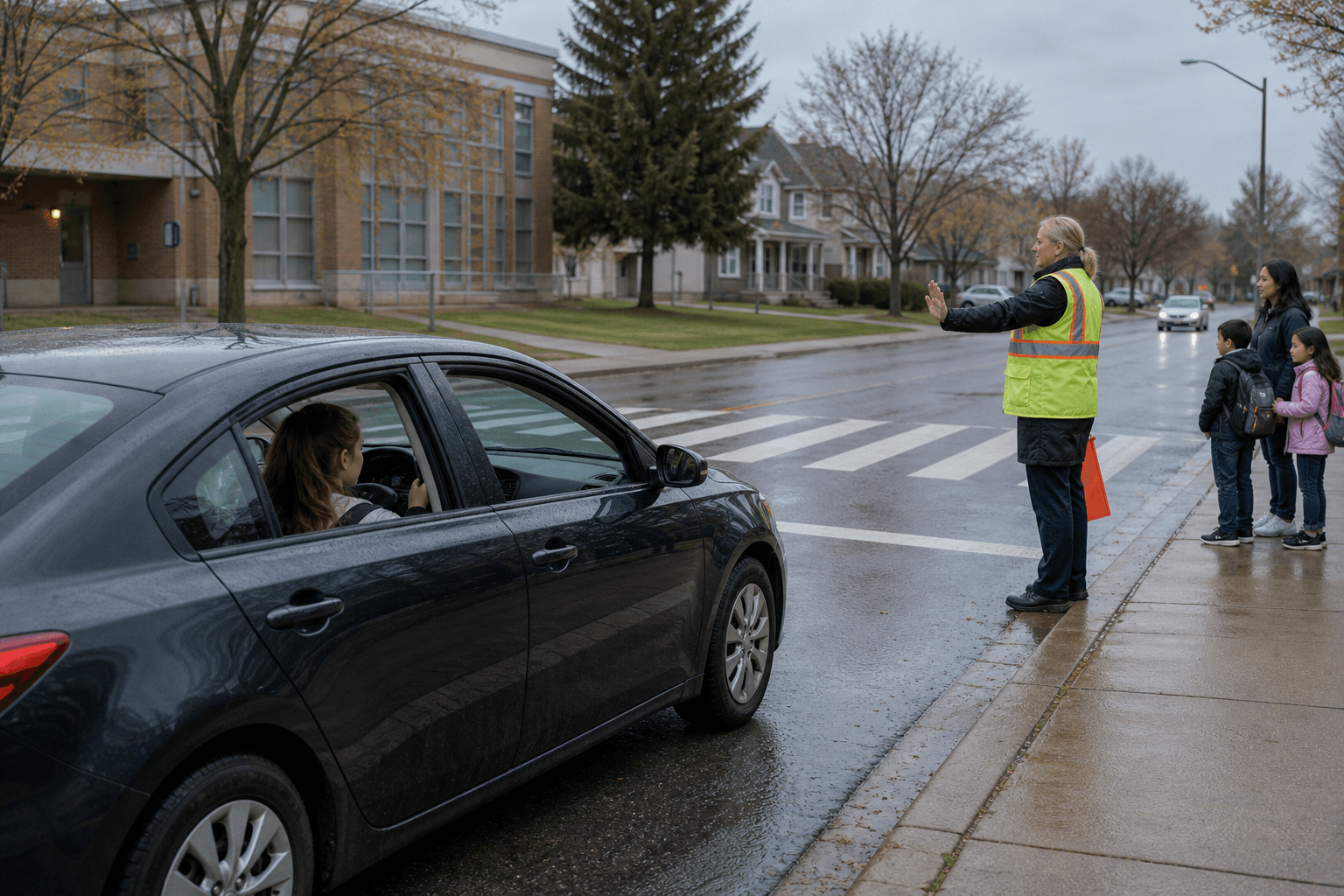
- School crossings: Reduce speed before the crossing and obey the crossing guard, signs and signals. Stop where directed, do not proceed around the guard or around children who are still crossing, and wait until the crossing is clear.
- Stopped school bus: Stop for a school bus displaying flashing red lights, from the required direction, and remain stopped until the lights stop flashing and the bus begins moving or the road is otherwise clear according to the applicable roadway arrangement.
- Transit buses: Watch for passengers, doors and people moving around a stopped bus. If a bus signals to leave a designated stop, slow down and yield when required for it to re-enter safely. Do not accelerate around it when passengers or pedestrians could enter your path.
- Streetcars: Expect passengers to cross between the curb and the streetcar when it is stopped. Stop behind the safety zone or at the required position, allow passengers to board or leave safely, and proceed only after the streetcar and crossing area are clear.
Ask, “Whose path will my vehicle cross, and have I confirmed that path is clear?” This catches hazards that a quick left-right glance can miss.
Roundabouts and traffic circles: yield before entering
At a roundabout, vehicles entering yield to traffic already circulating. Approach slowly, read the lane signs, check for pedestrians and select the correct lane before entering.
- Reduce speed as you approach.
- Yield to circulating traffic and wait for a safe gap.
- Stop for pedestrians at the entry or exit crossing when they are crossing or entering your path.
- Stay in the lane indicated for your intended exit.
- Do not change lanes inside unless markings and conditions allow it.
- Signal your exit and check the crossing before leaving.
If you miss your exit, continue around the roundabout and take the next safe exit. Do not stop in the circulating lane, reverse or cut across another vehicle to correct the mistake. Emergency vehicles are an exception to ordinary entry decisions: make room without stopping in the roundabout or blocking a crossing, and follow the direction of emergency personnel.
Emergency vehicles
When an emergency vehicle approaches with an activated siren or emergency lights, stay calm, check around you and create a clear path when safe. Signal, move toward the right side when possible and stop only where you will not block an intersection, crosswalk, roundabout or another lane of travel. Do not make a sudden move into another vehicle’s path. If you are already in an intersection, clear it first when safe, then pull over.
When another driver takes your right of way
If another driver proceeds when you expected to go first, yield rather than compete. Brake smoothly, keep the steering controlled, leave space and allow the conflict to clear. Avoiding a collision is more important than insisting on priority.
Khurana Driving School is based in Mississauga and provides G2 and G road-test training with a defensive-driving approach focused on control, judgement and safer road habits. The school serves learners in Mississauga, Brampton, Etobicoke and Toronto.
Common learner mistakes that change the outcome
| Common mistake | Precise correction |
|---|---|
| Rolling through a stop sign | Stop completely, scan both directions and check again. |
| Assuming the larger road always has priority | Read the signs and signals. Road size alone does not decide every conflict. |
| Looking only left | Scan left, right, ahead and the crossing area. |
| Treating a signal as permission to move | Signal, then wait for a safe gap and clear path. |
| Turning without checking a crosswalk or bike lane | Complete a deliberate mirror, shoulder and crossing check. |
| Waving another driver through | Do not direct someone into traffic you cannot fully see. |
| Entering because of pressure | Keep the vehicle controlled until the movement is safe. |
A practice plan for G1 and G2 learners
Practise right-of-way decisions in stages. Start with recognition and observation, then add movement complexity. The goal is consistent decision-making, not memorising one fixed route.
- Recognise controls: Identify stop signs, yield signs, lights, lane arrows, crossings and roundabout signs.
- Practise quiet controlled intersections: Work on complete stops, arrival order, mirror checks, signals and smooth starts.
- Add turning conflicts: Practise left turns across oncoming traffic and right turns across crossings, sidewalks and bike lanes.
- Use uncontrolled intersections: Rehearse simultaneous-arrival decisions and the left-yields-to-right rule.
- Build lane movement skills: Add lane changes, merging and entering a roadway.
- Increase complexity: Practise roundabouts, heavier traffic, buses, parked cars and pedestrians.
You are making progress when you can identify the control early, observe without repeated prompts, signal before moving, yield to the correct road user and complete the decision without abrupt braking or steering. For a broader sequence connecting these skills with test readiness, use this G2 test skills roadmap.
Saveable intersection checklist
- What sign, signal or lane marking controls this movement?
- Who is already in the intersection or lane?
- Is a pedestrian, cyclist, bus or streetcar crossing my path?
- Who arrived first, and if arrival was simultaneous, which vehicle is on the left?
- Is anyone turning, merging, changing lanes or entering the roadway?
- Have I checked mirrors, blind spots and the intended path?
- Can I proceed smoothly, or is waiting safer?
Right-of-way questions Ontario learners still ask
At an uncontrolled intersection in Ontario, who has the right of way?
When two vehicles arrive from different roads at the same time, the driver on the left yields to the driver on the right. If timing is unclear, wait.
Who goes first at a four-way stop when two vehicles arrive together?
The driver on the left yields to the driver on the right. If one vehicle turns left and the opposing vehicle goes straight, the left-turning vehicle waits.
Who has the right of way when turning left across oncoming traffic?
The left-turning driver waits for oncoming traffic going straight or turning right unless a protected signal or another control permits the turn.
Do pedestrians always have the right of way in Ontario?
Not in every location or circumstance. Signals, crossings, guards, signs, road position and safety conditions determine the response, but drivers must always scan for pedestrians and stop when a pedestrian’s path conflicts with the vehicle.
How should I handle a school crossing or stopped school bus?
Slow down before a school crossing, obey the crossing guard and stop as directed. For a school bus displaying flashing red lights, stop from the required direction and remain stopped until the lights stop flashing and the bus has moved or the roadway is clear under the applicable conditions.
What should I do around a streetcar or transit bus?
Slow down and watch for passengers crossing around a stopped vehicle. Stop behind the streetcar’s safety zone when required, allow passengers to board or leave safely, and yield to a transit bus re-entering traffic when the roadway and traffic conditions require it.
Who must yield when changing lanes or merging?
The driver changing lanes or merging must select a safe gap and yield to traffic already occupying the lane when the paths conflict.
What should I do if another driver takes my right of way?
Brake or wait as needed, keep control, create space and allow the other driver to clear. Do not accelerate to prove you were correct.
Who has the right of way in an Ontario roundabout?
Traffic already circulating has priority over vehicles entering. Approach slowly, yield before entry, follow lane markings, stop for pedestrians whose paths conflict with yours and never stop or reverse in the circulating lane.
What should I do when an emergency vehicle approaches?
Signal, move toward the right when safe and stop without blocking an intersection, crosswalk or roundabout. If you are already in an intersection, clear it first when safe, then pull over.
Turn the rules into safer driving habits
Right-of-way knowledge becomes useful when paired with observation, controlled speed, clear signalling and enough space to respond. Practise one scenario at a time, then add traffic and complexity as your decisions become consistent.
If you are in Mississauga, Brampton, Etobicoke or Toronto and want structured practice for these decisions, ask Khurana Driving School about G2 or G road-test preparation services.