
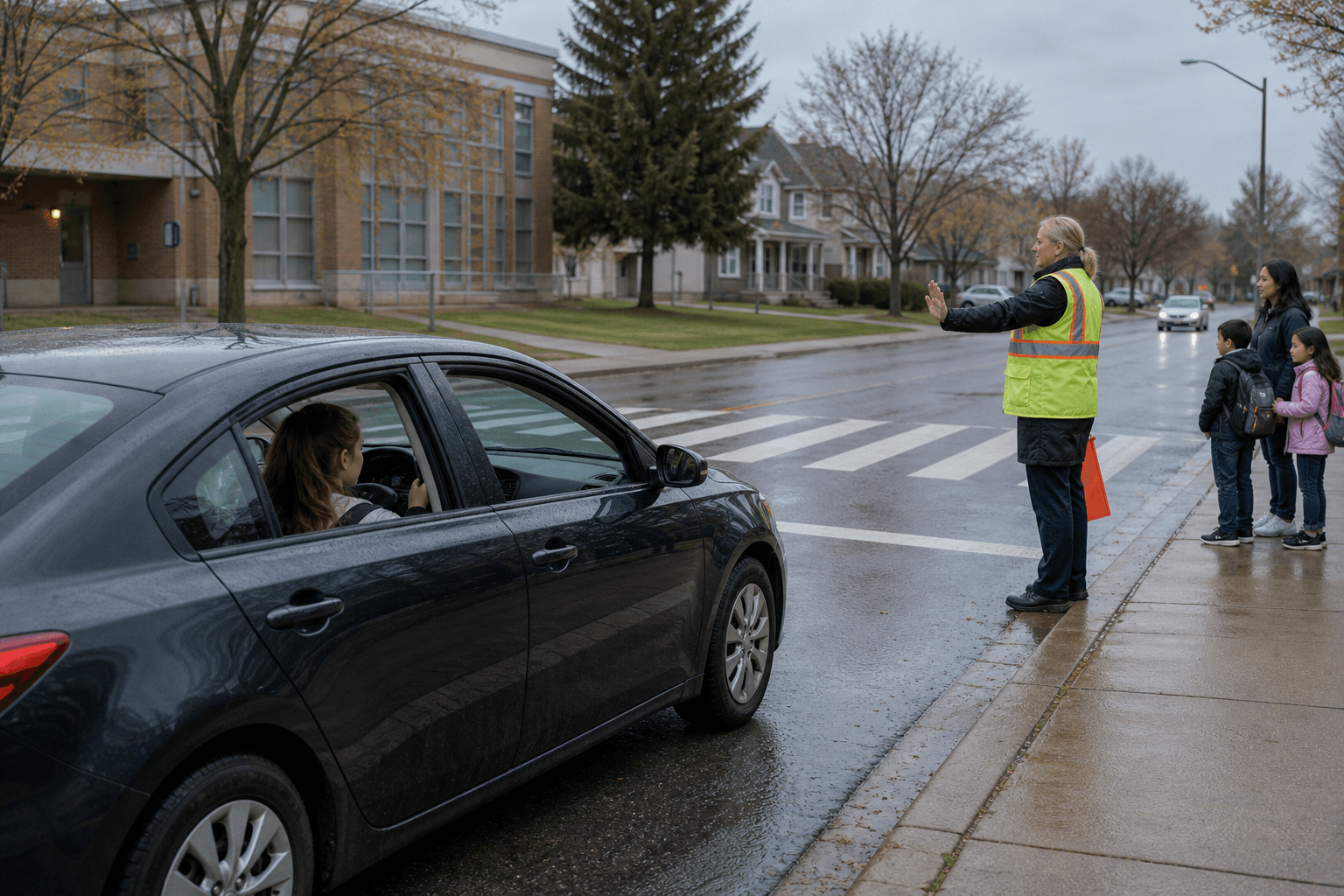
School-zone driving lessons in Ontario should teach more than slowing down. You should recognize the five-sided school-zone sign, reduce speed early, scan for children and parked vehicles, leave extra space, and stop and yield correctly at school crossings, pedestrian crossovers and crossing guards. School-zone practice is a focused part of G2 or G preparation, not a complete substitute for broader road-test training. Related reading: Driving school trans canada st laurent.
What school-zone driving lessons should teach in Ontario
A useful lesson turns a school-area approach into a repeatable decision: identify the control, reduce speed, search for hazards, prepare to stop and proceed only when the roadway is safe. The goal is calm, deliberate driving around children, pedestrians, parked vehicles, buses, driveways and unpredictable movements.
Ontario’s Official MTO Driver’s Handbook describes a school-zone sign as a five-sided sign with a fluorescent yellow-green background and black symbols. It warns that you are approaching a school zone, where you should slow down, use extra caution and watch for children. The sign itself does not create a universal school-zone speed limit. Ontario’s school-zone sign guidance explains the warning sign and its intended response.
A focused lesson should also show you how a school-zone warning differs from a school crossing, a crossing guard and a pedestrian crossover. Those situations require different visual checks and, in the case of crossings and crossovers, specific stopping and yielding behaviour.
School zone, school crossing or pedestrian crossover: know the control
A school zone is an area where the sign warns you to expect children and increased pedestrian activity. A school crossing or pedestrian crossover is a crossing location where drivers must stop and yield in the circumstances set out by Ontario law and traffic controls.
School-zone warning sign
When you see the five-sided fluorescent yellow-green sign, begin adjusting your driving before you reach the busiest point. Ease off the accelerator, scan both sidewalks and driveways, look between parked vehicles and be ready for a child or pedestrian to enter your path.
Follow the posted speed limit and any applicable traffic signs. A school-zone sign is a warning to drive cautiously, not permission to travel 10 kilometres per hour over the posted limit. Ontario has no general rule allowing drivers to go 10 over.
School crossing and crossing guard
At a school crossing or a location with a crossing guard, drivers must stop and yield the entire width of the roadway to pedestrians and crossing guards. You may proceed only after pedestrians and crossing guards have crossed and are safely on the sidewalk. Ontario’s crossing guidance sets out this obligation.
If a school-crossing guard displays a red-and-white stop sign, stop before reaching the crossing. Remain stopped until everyone, including the crossing guard, has cleared the entire roadway and it is safe to continue. The MTO’s school-crossing stopping guidance explains when the roadway is clear enough to proceed.
Pedestrian crossover
A pedestrian crossover is a designated crossing where drivers must stop and yield to pedestrians crossing the entire width of the roadway. Look for crossing signs, pavement markings and people waiting or entering. Stop far enough back to leave the crossing visible and usable, then wait until the person has safely cleared the roadway.
Newcomers should give themselves time to learn Ontario-specific signs, right-of-way rules and defensive driving principles. A familiar-looking sign or crossing arrangement may create a different legal response in Ontario.
A repeatable approach for driving near a school
Use this routine each time you approach a school area. An instructor can observe whether you are making each decision early enough, not just whether you eventually slow down.
- Identify the control. Look for a school-zone warning sign, marked crossing, pedestrian crossover, crossing guard, traffic lights or stop sign.
- Reduce speed early. Ease off the accelerator before the crossing or busiest pedestrian area.
- Search broadly. Scan sidewalks, parked vehicles, school entrances, driveways, intersections and the space behind the vehicle ahead.
- Prepare to brake. Focus on areas where a person could enter the roadway and be ready to stop smoothly.
- Create space. Begin with at least a two-second following gap in good conditions and increase it for traffic, poor visibility, rain, snow, ice, darkness, hills or curves. Practise the following distance guidance for changing Ontario road conditions.
- Stop when required. Stop before a school crossing or pedestrian crossover when a pedestrian or crossing guard is crossing or entering as required.
- Proceed smoothly. Once the crossing is clear, check again, release the brake gradually and continue at a safe speed.
Ontario’s traffic-sign regulation allows municipalities to erect community-safety-zone school signs near schools, including along a highway within 150 metres beyond school property where the municipality establishes the sign. Read the displayed instruction instead of relying on a memorized distance.
How rain, darkness and congestion change the lesson
The same school-area routine becomes more demanding when you cannot see or react as quickly. The correct adjustment is usually earlier speed reduction, a larger space cushion and a wider visual search.
| Condition | What changes | What to practise |
|---|---|---|
| Rain | Wet pavement and spray can reduce grip and visibility. | Slow earlier, use suitable wipers and lights, increase following distance and scan through gaps. |
| Snow or ice | Braking and steering take longer, while snowbanks may hide children or signs. | Leave more room, avoid abrupt inputs and search beyond snowbanks and parked vehicles. |
| Darkness or glare | People, clothing and markings are harder to see. | Reduce speed to available visibility, keep the windshield clear and watch road edges. |
| Congestion and school pickup | Vehicles may stop, turn or open doors unexpectedly. | Reduce speed before the queue, avoid passing stopped vehicles near a crossing and keep it visible. |
| Hills, curves and blocked sightlines | You may not see a child, guard or stopped vehicle until close. | Adjust before the obstruction, maintain a larger gap and expect stopped traffic beyond it. |
Do not assume a school-zone camera is operating or use camera expectations to decide how fast to drive. Ontario Regulation 306/25 revoked the former automated-speed-enforcement regulation on December 12, 2025, and the province says municipal cameras are being replaced with traffic-calming measures and targeted enforcement. Follow posted limits, signs and road conditions instead. See the current automated-speed-enforcement regulation and Ontario’s speed-reduction information.
What to practise during an in-car school-zone lesson
Effective school-zone driving lessons use observable goals. You should receive feedback on when you noticed the sign, how early you adjusted speed, where you looked, whether you left enough space and how you responded to a crossing guard or pedestrian.
- Sign recognition: Identify the school-zone warning sign and distinguish it from crossing and crossover controls.
- Early speed control: Reduce speed smoothly before the hazard.
- Hazard scanning: Search 15 to 20 seconds ahead where possible, then return attention to immediate hazards.
- Stopping position: Stop before the crossing or stop line, keep it visible and wait when required.
- Space management: Maintain a suitable gap and avoid driving beside another vehicle where a pedestrian could be hidden.
These skills support broader defensive driving because they help you anticipate hazards. They can also support G2 or G preparation, which may include intersections, parking, merging, lane changes, highway exposure and other test-related skills. School-zone practice alone does not cover every requirement of either road test.
Ask the instructor to give you one clear target at a time. A first pass might focus on recognizing controls and reducing speed early. A later pass can add crossing-guard decisions, following distance, lane position and communication. If you make a mistake, identify what you saw too late, correct the decision safely and repeat the situation at a manageable pace.
Worked example: a nervous learner approaches a busy school crossing
Hypothetical example: You are a new driver approaching a busy school area in light rain. Parked vehicles narrow your view, several pedestrians are near the sidewalk and a crossing guard steps toward the roadway with a red-and-white stop sign.
Release the accelerator early and scan the sidewalk, gaps between parked vehicles and opposite side of the road. Because rain and parked vehicles reduce visibility, leave more space and prepare for a longer stop.
Stop before the crossing, not beside the guard or in the marked area. Remain stopped while pedestrians and the crossing guard cross the entire roadway. Once everyone has cleared the roadway and it is safe, check again, move smoothly and continue cautiously.
How to choose school-zone driving lessons in Ontario
The best driving lessons for a nervous beginner are individual, active and paced to current ability. Look for an instructor who explains each correction, allows time to repeat the skill and connects school-zone decisions to broader defensive-driving expectations.
Questions to ask before booking
- Will the lesson include school-zone signs, crossings, pedestrian crossovers and crossing-guard situations?
- How much is active in-car coaching, and how long is each session?
- How will the instructor adapt the pace for a beginner, newcomer or nervous driver?
- What is the price of an individual lesson, and what is included in a package?
- Are pickup and drop-off available, and does that time count as lesson time?
- What vehicle, insurance and test-day arrangements apply to later G2 or G preparation?
- Are evening or weekend lessons available, and how are changes handled?
- What qualifications does the instructor hold, and is the school approved if I specifically seek a BDE course?
Ontario government-approved driving schools must be licensed and meet requirements for in-class and in-vehicle training, administration and advertising. The province advises learners to check approval status and the revoked-schools list. If you seek an approved Beginner Driver Education course, confirm that status directly instead of assuming private lessons are BDE.
A ministry-approved BDE course must include at least 40 hours: 20 hours of classroom instruction, 10 hours of in-vehicle instruction and 10 hours of flexible instruction. That structure differs from individual school-zone practice or a short road-test lesson.
Common booking questions
How much is a driving lesson in Ontario? There is no single Ontario price. Cost depends on lesson length, location, instructor time, number of sessions, BDE or private instruction, and extras such as vehicle use or test-day services. Ask for the current price and written inclusions before paying.
Are 20 lessons enough to pass? No fixed number guarantees readiness or a pass. Judge readiness by consistent performance across several conditions, not by the number purchased.
What is the hardest part of driving school? For many beginners, it is combining speed control, hazard scanning, space judgment and calm responses. Good instruction breaks that workload into smaller tasks and combines them gradually.
Can you start driving school at 15 in Ontario? Ontario’s licensing eligibility and G1 rules determine when you can begin the licensing pathway. Check current MTO requirements before booking a course or planning a road test.
Which road-test preparation service offers evening and weekend lessons? Khurana Driving School lists evening and weekend lessons, G2 and G preparation, and flexible scheduling. Ask which times, lesson lengths and school-zone options are currently available.
Where Khurana Driving School may fit this goal
Khurana Driving School’s homepage lists G2 and G driving lessons, evening and weekend lessons, and a defensive-driving approach. Those offerings may be relevant if you want to connect school-zone practice with broader licence preparation.
Ask specifically what school-area situations the instructor can cover, how active coaching is delivered, how long the lesson lasts, what the current price includes, whether pickup arrangements apply and how focused practice connects to your wider G2 or G plan.
Plan your next focused practice session
Choose one school-area goal before your next drive: recognizing the control early, stopping correctly for a crossing guard, improving scanning around parked vehicles or increasing space in poor conditions. For broader preparation, Khurana Driving School can discuss G2 and G road-test preparation services alongside focused defensive-driving practice.