
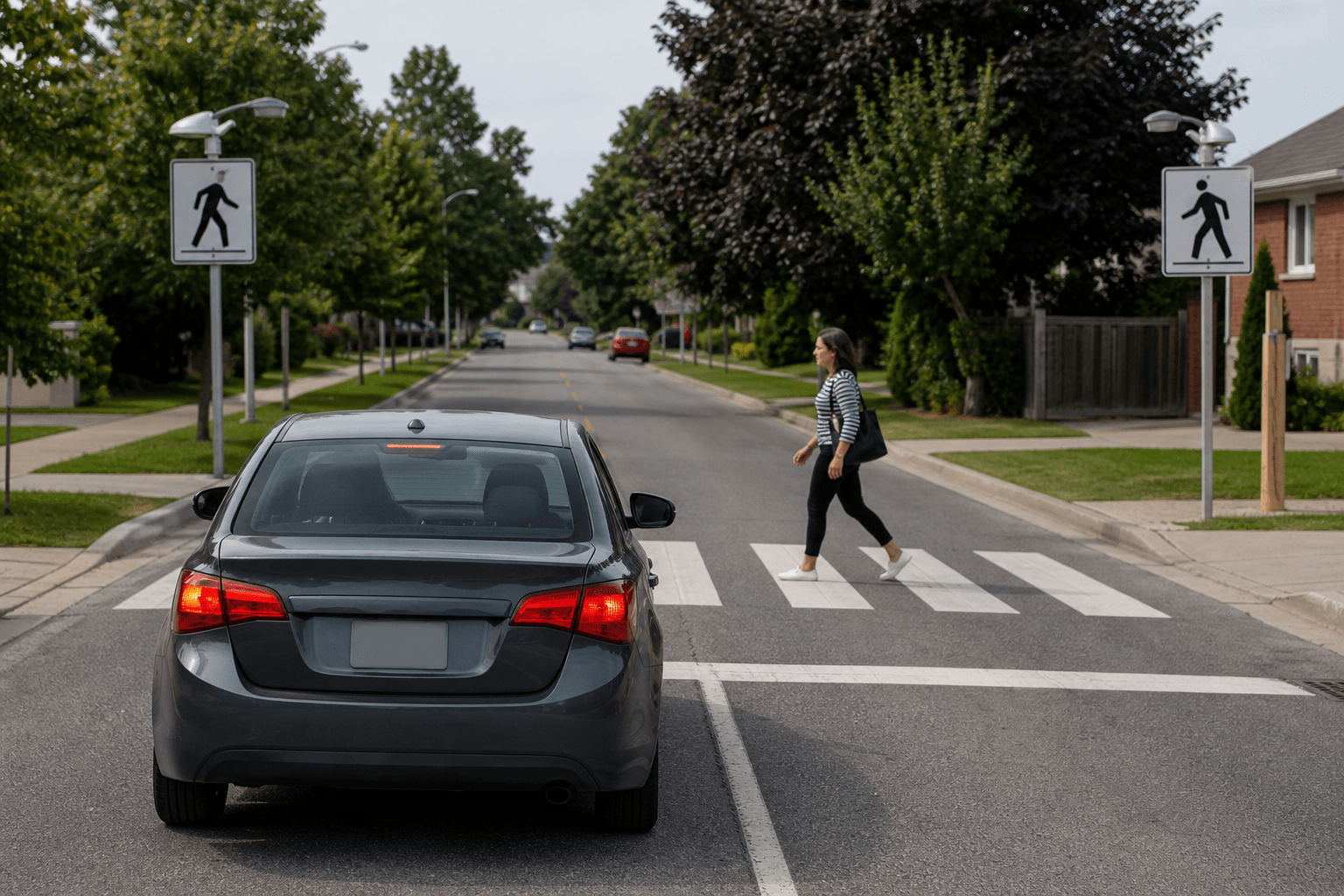
In Ontario, the correct response depends on the crossing type. At a pedestrian crossover, school crossing or location with a crossing guard, stop and yield the entire roadway when required, then wait until pedestrians and crossing guards have crossed and are safely on the sidewalk before proceeding. A reliable lesson routine is: identify the control, reduce speed early, scan broadly, stop smoothly, wait, check again and proceed only when clear.
Ontario crossing types: identify the control before you act
Not every place where people cross the road has the same controls or stopping duty. Before deciding what to do, look for signs, pavement markings, traffic signals, pedestrian signals and crossing guards.
| Crossing situation | What to look for | Driver response |
|---|---|---|
| Pedestrian crossover | Pedestrian-crossover signs, overhead yellow lights and distinctive pavement markings | Stop before the line when a pedestrian is crossing or entering as required, yield the roadway and wait until the pedestrian has completely crossed and cleared it. |
| School crossing | School-crossing signs, markings or a designated crossing area | Stop and yield when the crossing is being used as required. |
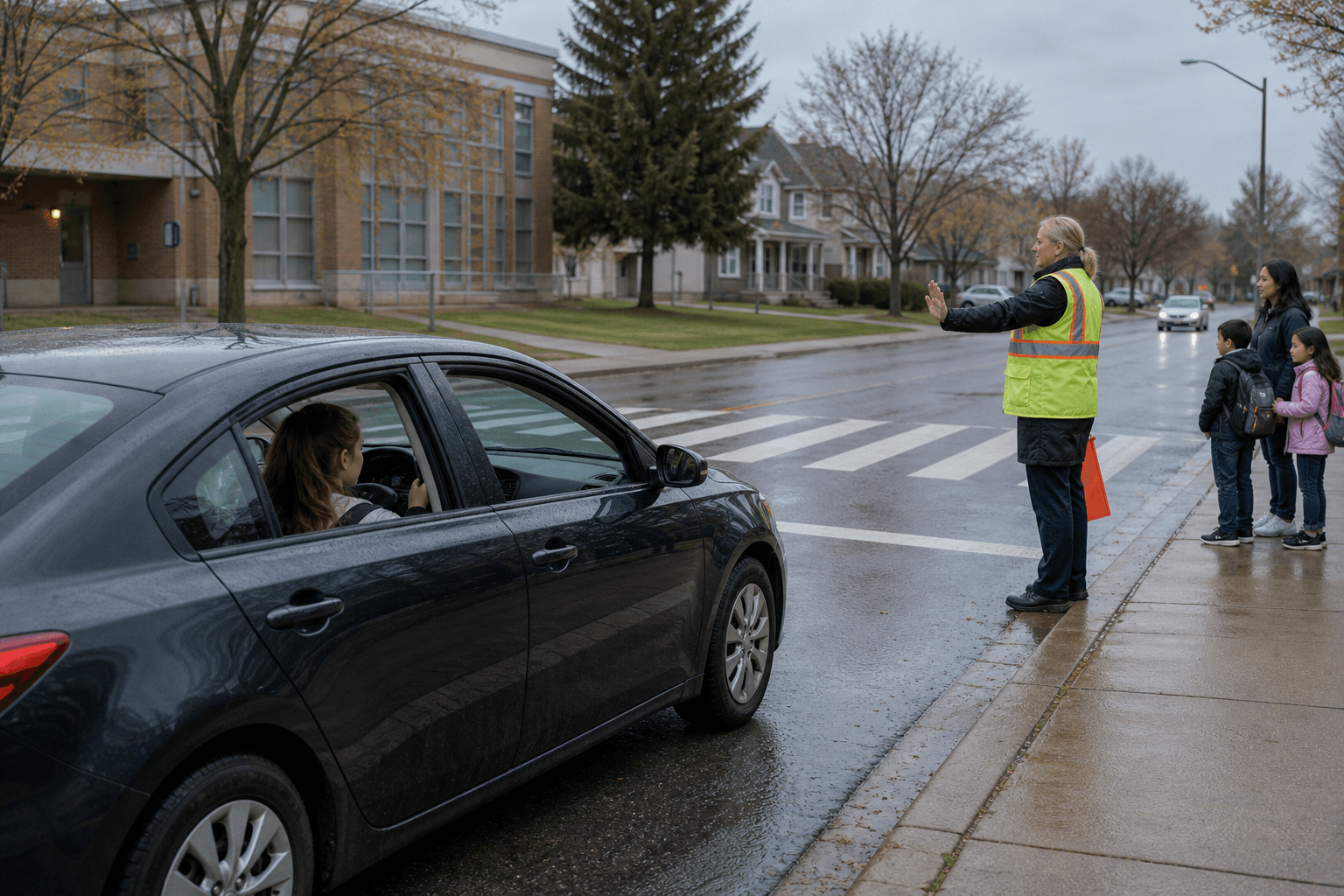
| Crossing guard location | A crossing guard directing people across the road | Stop and yield the entire width of the roadway. Proceed only after pedestrians and the crossing guard are safely on the sidewalk. |
| Traffic-light-controlled intersection | Vehicle traffic lights and pedestrian walk or hand signals | Obey the vehicle signal, check for pedestrians before turning and yield across a pedestrian’s path when required. |
| Ordinary crosswalk | Marked crossing without a pedestrian crossover control | Follow the applicable signs, signals and right-of-way rules. Do not assume every marked crosswalk has the same legal response as a pedestrian crossover. |
Ontario identifies pedestrian crossovers through signs, overhead yellow lights and pavement markings. At these crossovers, drivers must stop before the line and yield until pedestrians have completely crossed and cleared the roadway. Ontario’s pavement-marking guidance explains the visual differences.
If you need to practise several crossing controls in context, school-zone driving lessons can help connect sign recognition, speed control, scanning and stopping decisions.
The six-part approach: slow, scan, stop, wait and proceed
Ontario pedestrian-crossing rules are easiest to apply as a repeatable sequence: recognize the control, reduce speed, scan, prepare to stop, stop and wait when required, then check again before proceeding.
1. Recognize the crossing control
Start looking well before the crossing. Identify whether you are approaching a pedestrian crossover, school crossing, crossing guard, traffic signal or ordinary crosswalk.
2. Reduce speed early
Ease off the accelerator before the crossing, especially near parked vehicles, schools, bus stops, driveways or crowded sidewalks. Early speed control keeps braking smooth.
3. Scan the full approach
Look left and right along the sidewalks, toward entrances and behind parked vehicles. Check mirrors and avoid focusing only on the person closest to the crossing.
4. Prepare to stop
Cover the brake without braking sharply. Keep enough space ahead to stop before the stop line or crossing. In good conditions, use at least a two-second following distance as a starting point, then increase it for rain, snow, darkness, poor visibility, congestion, hills or curves. Following distance guidance helps you create the space needed to see and react.
5. Stop and wait when required
At a pedestrian crossover, school crossing or location with a crossing guard, stop and yield the entire width of the roadway when a pedestrian or crossing guard is crossing or entering as required. Stop before the line or crossing and remain stopped while the person is still crossing.
6. Check again and proceed smoothly
Do not move simply because the person has reached your lane. Check the remaining lanes, the sidewalk and your mirrors. Proceed only when the crossing is clear and the applicable signal or control permits movement.
Signals, waiting pedestrians and turning vehicles
A pedestrian signal tells pedestrians when to cross, but it does not replace your responsibility to observe the road. A walking signal or countdown does not give a driver permission to accelerate through a crossing or turn without checking for people already in the roadway.
What if a pedestrian is waiting at the curb?
A person standing at the curb has not necessarily entered the crossing, so the exact duty depends on the crossing type, signals and the person’s movement. Slow, cover the brake, identify the control and be ready to stop.
What if you are turning?
Turning drivers must scan the path they are about to cross. Signal, turn slowly and yield to pedestrians who have the right of way under the applicable signal or crossing control. A green vehicle signal does not mean the path is automatically clear.
How long should you wait?
There is no single number of seconds for every pedestrian signal or crossing. Wait until the pedestrian, crossing guard or other person using the crossing has crossed and is safely clear, then check again before moving.
Real-world crossing scenarios learners need to practise
The hardest decisions happen when visibility, traffic or another road user makes the crossing difficult to read. Practise the decision itself, not just the location.
A pedestrian has already entered the crossing
Hold your position and yield. At a pedestrian crossover, school crossing or crossing-guard location, wait until the person has crossed the roadway and is safely clear. Do not inch forward to pressure the pedestrian.
A person is approaching from the side
Reduce speed and watch the person’s path and distance from the curb. If the person enters or is about to enter a controlled crossing, stop before the line and yield as required. Do not rely on eye contact.
There are multiple lanes
Stopping in your lane does not mean the crossing is clear. Keep watching the full roadway and wait for pedestrians to clear every lane.
A cyclist is using or approaching the crossing
Slow down and leave the cyclist room to cross or dismount safely. At a pedestrian crossover, the official stopping and yielding rule applies to drivers and cyclists. Treat a cyclist near the crossing as a moving road user.
Traffic, parked vehicles or darkness block your view
Reduce speed earlier and increase your following space. Never move around a vehicle that blocks your view of the crossing. If you cannot see whether the roadway is clear, hold your position until you can see safely.
In rain, snow, fog or darkness, scan farther ahead, avoid sudden acceleration and leave more room to stop. Do not guess what is behind an obstruction.
Passing near a pedestrian crossover: the mistake that removes your view
Ontario prohibits passing within 30 metres of a pedestrian crossover. You must also not pass a vehicle stopped at a pedestrian crossover to allow pedestrians to cross.
A stopped vehicle can hide a pedestrian, wheelchair user or cyclist. Remain behind the vehicle and wait. The MTO handbook sets out these restrictions in its guidance on changing positions near a pedestrian crossover.
Turn crossing rules into driving-lesson practice
Use this self-assessment during supervised practice. Score each approach as consistent, developing or not yet reliable, then focus the next lesson on the weakest behaviour.
- Control recognition: Did you identify the crossing type, signs, markings, signals or crossing guard?
- Early speed adjustment: Did you reduce speed early enough to stop smoothly?
- Broad scanning: Did you check both sidewalks, parked vehicles, driveways and every lane?
- Space management: Did you increase your gap when visibility or traction was reduced?
- Stopping position: Did you stop before the line or crossing without blocking the pedestrian’s path?
- Yielding: Did you wait until the full roadway was clear where required?
- Resumption: Did you check again and proceed smoothly?
Choose several crossing environments during a supervised drive. Before each one, identify the control, where you would stop and what would make you wait. Afterward, review whether you looked early enough and responded to the actual control.
These behaviours support G2 and G preparation because they show observation, anticipation, speed control, space management and yielding.
Choose the right pedestrian-crossing lesson focus
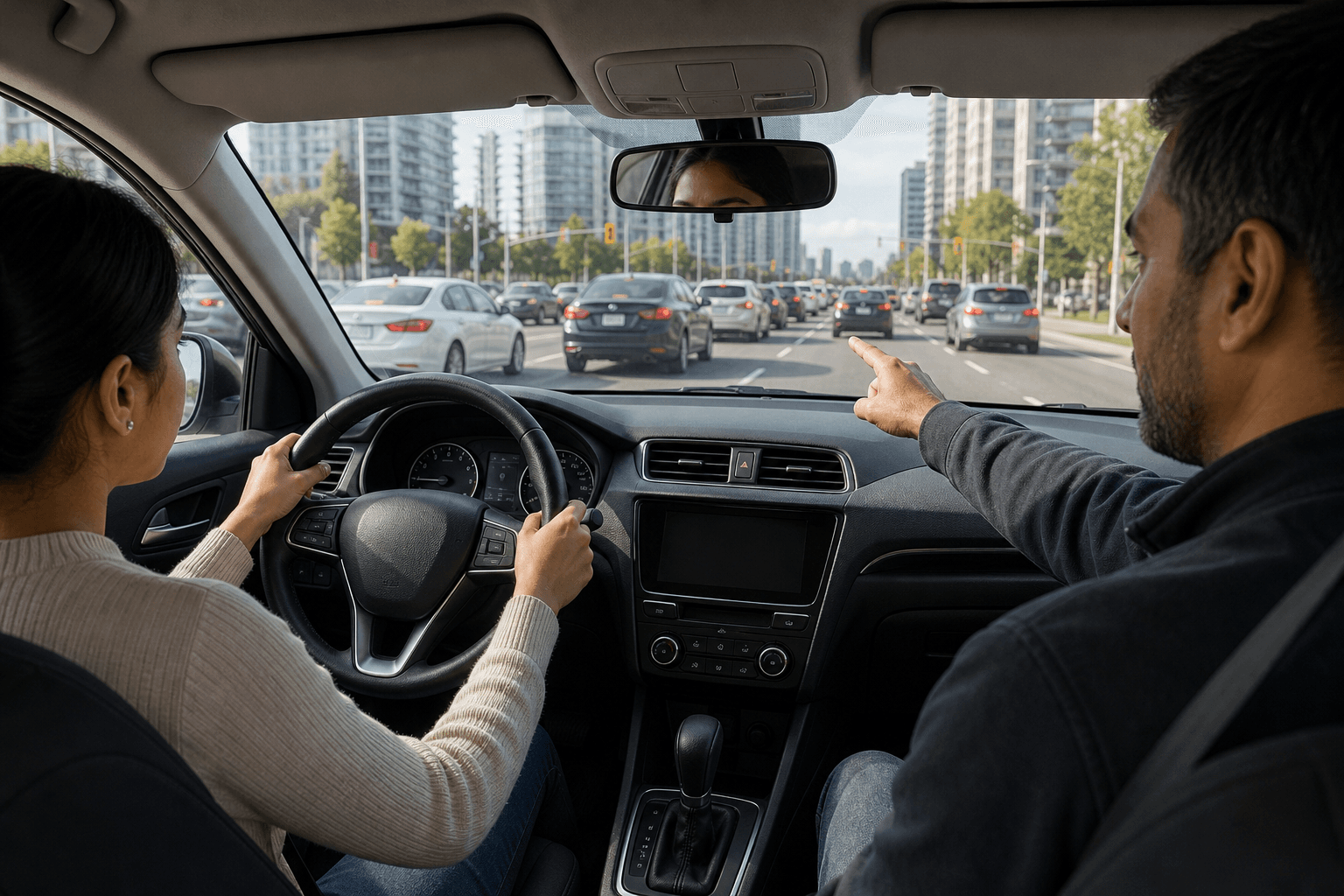
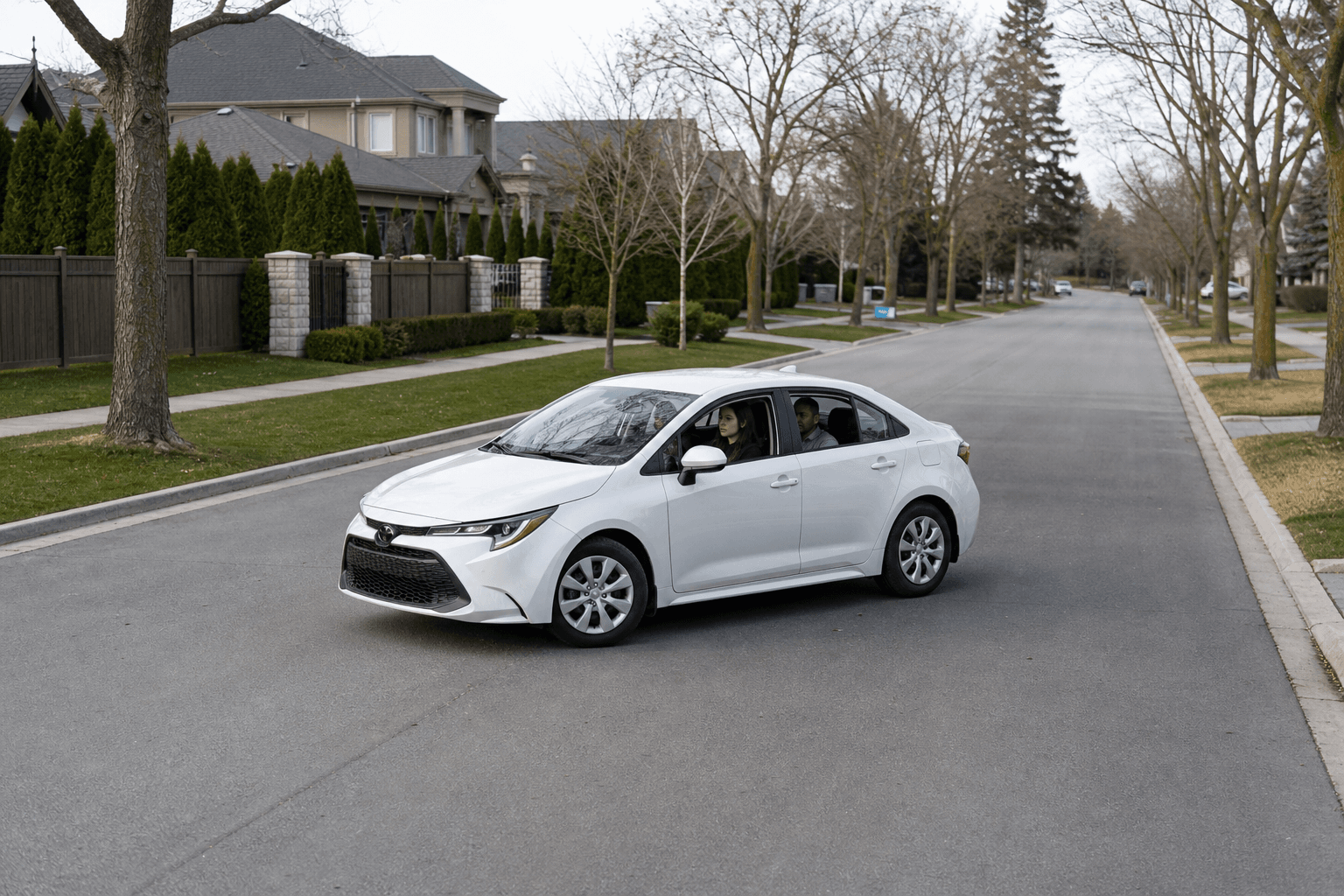
Beginners benefit from quiet-road practice that builds steering, braking and sign recognition before busier crossings are introduced. Nervous drivers often progress better when an instructor breaks one approach into small decisions and gives specific feedback.
G2 learners can combine crossing practice with intersections, turns, lane changes and parking. G drivers may need more complex traffic, higher speeds, merging decisions and earlier hazard scanning. Defensive-driving practice connects the legal stop-and-yield rule with anticipation, visibility and space.
Khurana Driving School offers G2 and G driving lessons, a defensive-driving approach, and evening and weekend lessons. Ask about the lesson format that matches your licence stage and pedestrian-crossing practice goals. Related reading: Driving school trans canada st laurent.
Questions learners still ask about pedestrian crossings
What is the difference between a pedestrian crossover and a crosswalk in Ontario?
A pedestrian crossover is a specifically controlled crossing identified by signs, yellow lights and pavement markings, with a defined stop-and-yield response. “Crosswalk” is a broader everyday term, so check the signals, signs, school-crossing controls and whether a crossing guard is present.
Do I have to stop if a pedestrian is waiting at the curb?
Not every person waiting at every curb creates the same stopping duty. Slow down, identify the control and prepare to stop. If the person enters or is entering a pedestrian crossover, school crossing or crossing-guard location as required, stop and yield the entire roadway.
Can I pass a vehicle stopped at a pedestrian crossover?
No. You must not pass a vehicle stopped at a pedestrian crossover to allow pedestrians to cross, and passing within 30 metres of a pedestrian crossover is not permitted.
How can I practise pedestrian crossings before my G2 or G test?
Practise identifying the control, reducing speed early, scanning all lanes, stopping before the line, waiting until clear and resuming smoothly. Use supervised practice with different crossing types and request focused G2 or G preparation for any recurring weakness.
Safe crossing decisions come from seeing the control early, preserving space and refusing to guess when your view is blocked. For learners in Mississauga, Khurana Driving School offers G2 and G driving lessons that can support practice matched to your licence stage and goals.