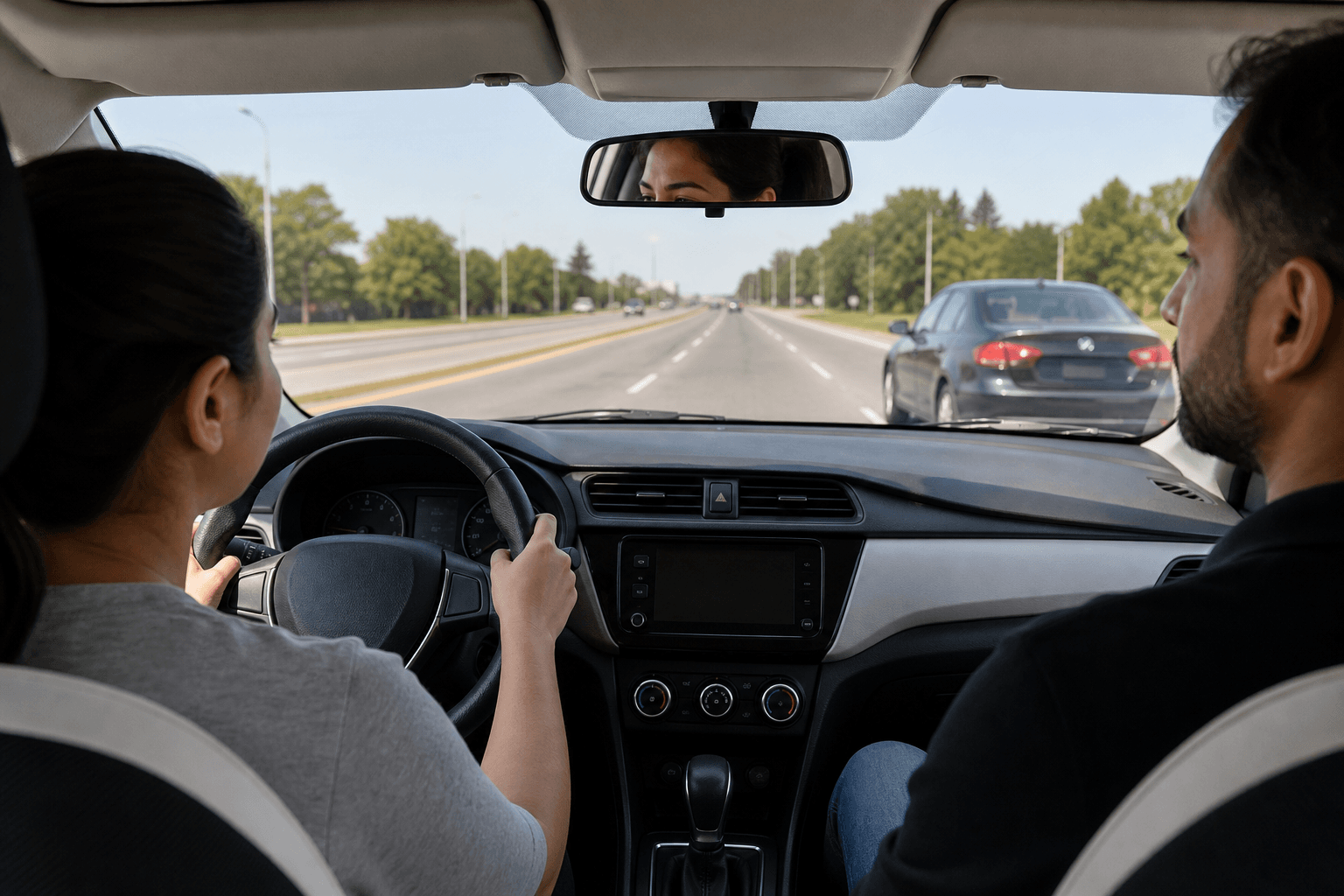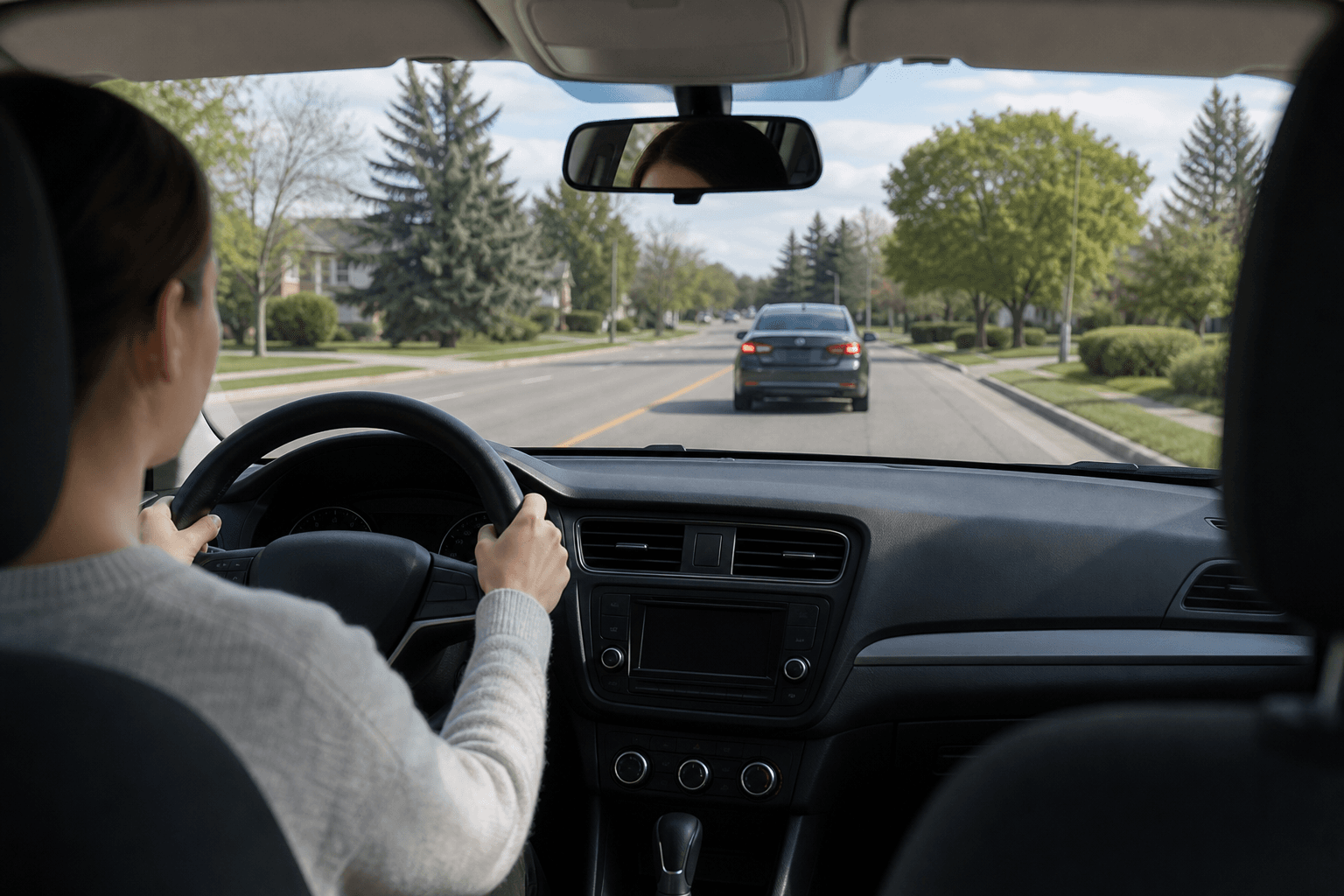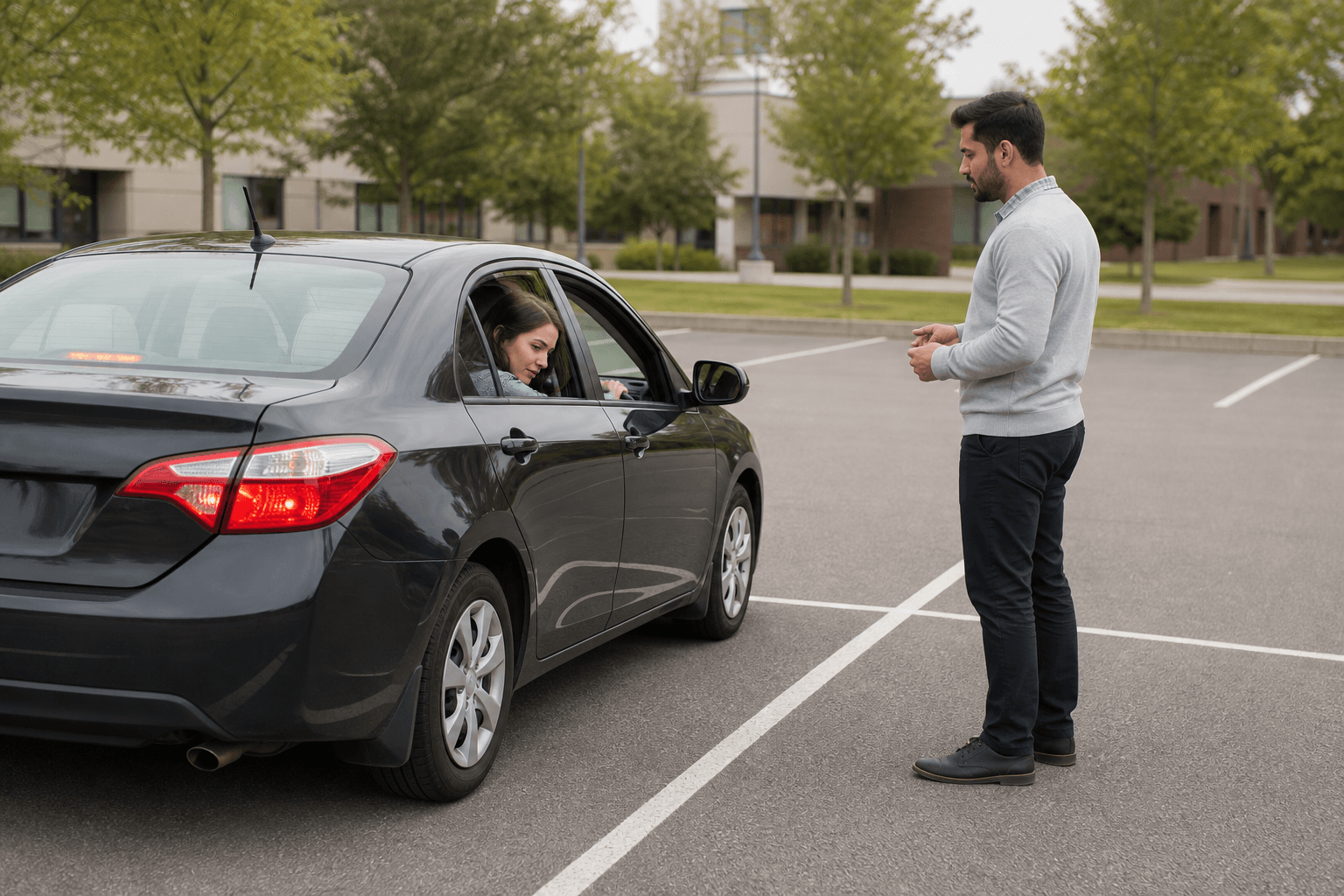

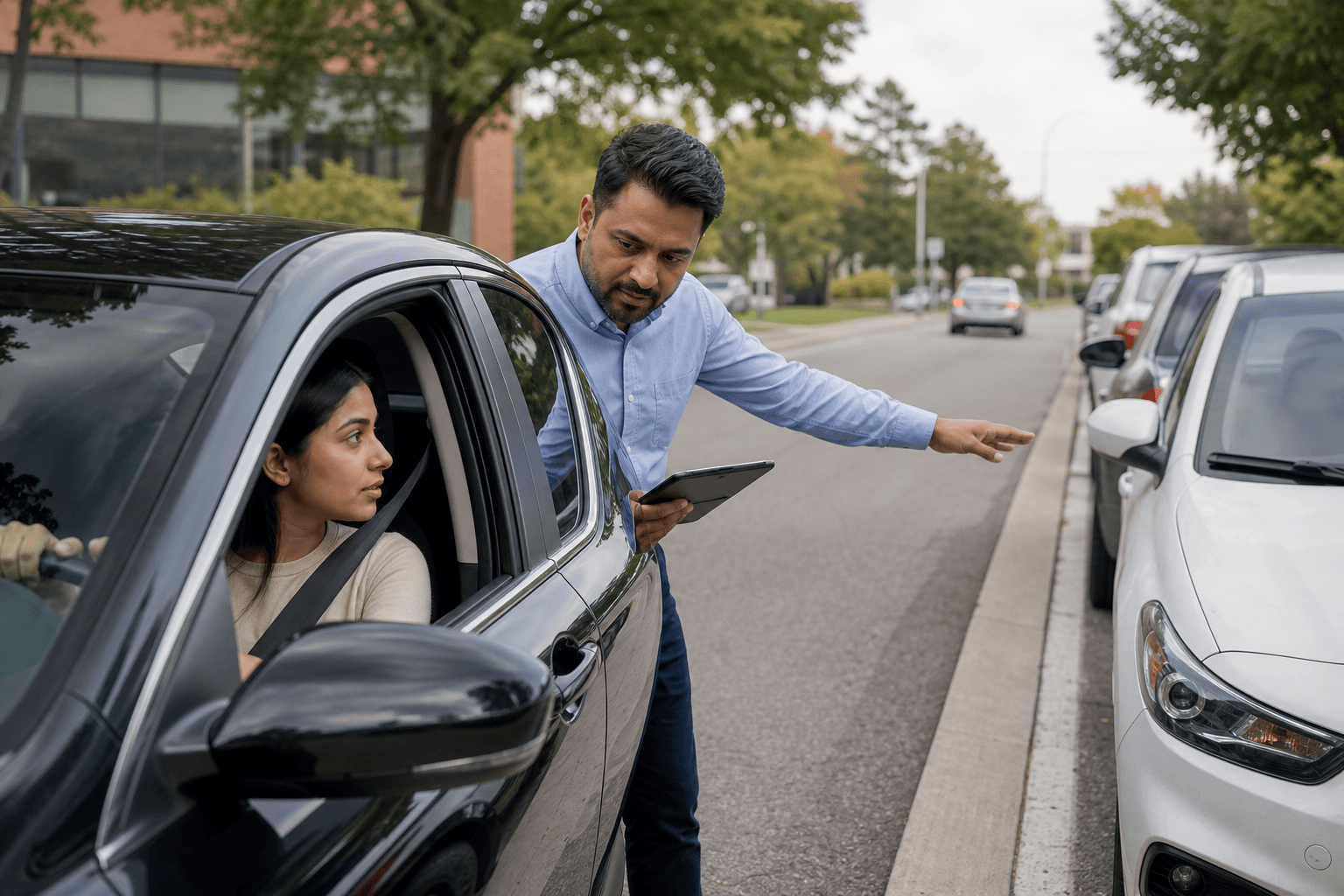
Effective parallel parking training is not about memorizing one steering formula. It is about building a repeatable routine: observe carefully, position the vehicle safely, move slowly, steer with control, and check your final clearance.
Targeted practice is especially useful when parking is your main weakness, but it should be combined with the other skills assessed in Ontario’s G2 road test. For learners in Mississauga, Brampton, and the GTA, the right choice may be independent practice, general driving lessons, or one-on-one coaching.
Quick summary
- Parallel parking is part of Ontario’s Level Two, or G2, road test.
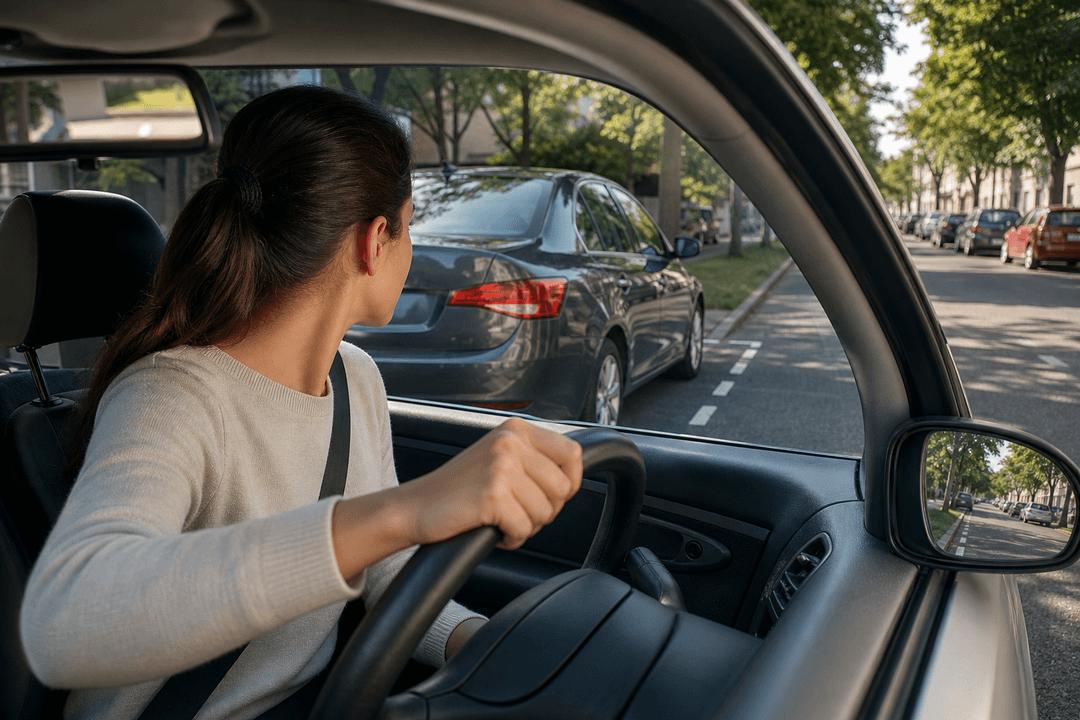
- Before reversing, check around the vehicle, your mirrors, and both blind spots.
- Use a vehicle-adapted routine instead of relying on a fixed number of steering turns.
- Practise parking alongside turns, lane changes, controlled stops, and expressway driving.
- One-on-one coaching can help when you repeat the same error or feel nervous without feedback.
What Ontario’s G2 test expects during parallel parking
Ontario’s Level Two road test includes parallel parking. The official handbook says that, before backing up, you should look around the vehicle and check your mirrors and both blind spots. Do not begin reversing until the way is clear or other traffic has stopped to allow you to park. Ontario’s Level Two road-test guidance explains this observation requirement.
Parallel parking also involves more than getting close to the curb. You need to signal appropriately, choose a suitable space, remain aware of nearby road users, control the vehicle at a slow speed, and finish in a safe position. Ontario’s handbook describes parallel parking as positioning the vehicle parallel and next to the curb or side of the road where parking is permitted. It notes that a space about one and one-half times the vehicle’s length is appropriate for right-side parallel parking. The handbook’s parking guidance provides the official description.
As of October 21, 2026, the supplied Ontario handbook evidence identifies parallel parking as a G2 skill, not a current G road-test task. This does not make parking practice unimportant. Good parking control supports safer observation, steering, spacing, and low-speed manoeuvring after the test as well.
A practical parallel parking training framework
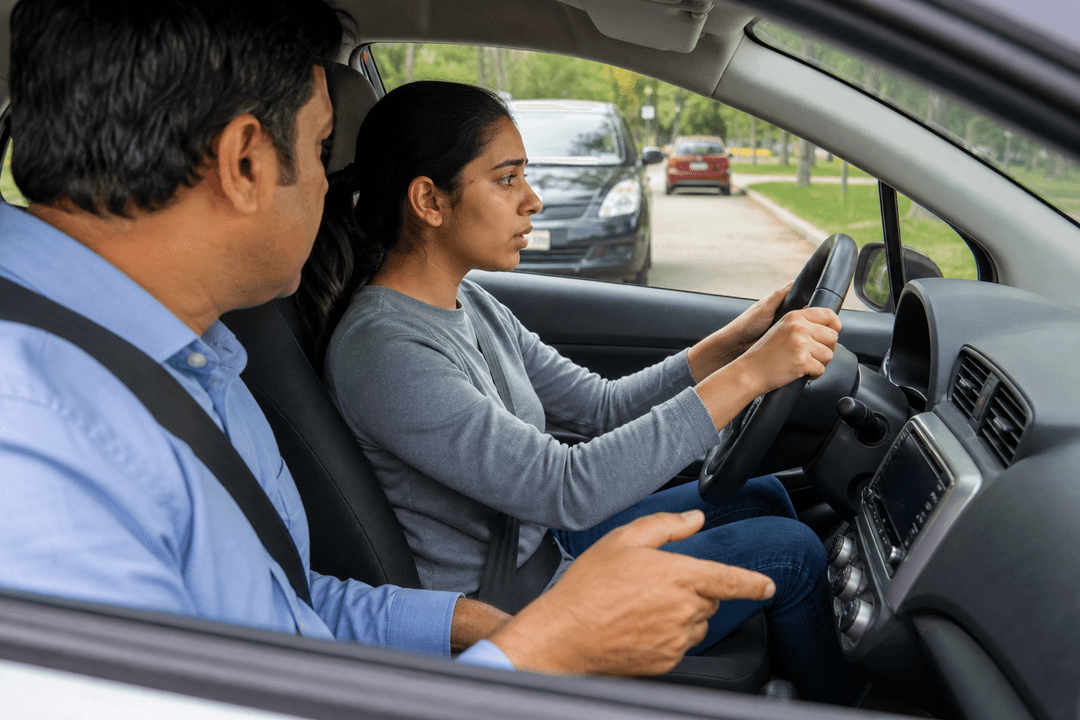
Practise in a legal, low-risk area with a qualified supervising driver where required. Choose a space that gives you enough room to learn, then reduce the available space gradually as your control improves. Do not force a difficult manoeuvre before you can perform the basics safely.
1. Prepare before moving
Approach at a controlled speed and identify the space early. Check signs, curb restrictions, pedestrians, cyclists, parked vehicles, and approaching traffic. Signal in good time so other road users understand your intention.
Your exact starting position will vary with the vehicle, available space, road width, and traffic conditions. Avoid treating a particular distance from the parked vehicle as universally correct.
2. Observe before reversing
Stop if necessary and complete a deliberate observation routine. Check around the vehicle, use your mirrors, and check both blind spots before reversing. Continue looking for people, bicycles, vehicles, and changing traffic conditions rather than treating the first check as permission to stop observing.
3. Move slowly and steer progressively
Use gentle accelerator control or controlled braking so the vehicle moves slowly enough for you to assess its position. Turn the steering wheel progressively as the vehicle enters the space, watching how the front and rear corners move. A slow vehicle gives you time to correct.
Do not concentrate only on the rear wheel or curb. Keep checking the front corner, the vehicle behind you, the curb, and the road around the vehicle. The correct steering response depends on the car’s size, turning behaviour, and current angle.
4. Make a calm correction when needed
A correction is not automatically a failure. If the vehicle is not tracking safely into the space, stop, reassess, and make a controlled adjustment when the surroundings are clear. Continuing with a poor angle simply to avoid correcting can create a larger safety or positioning problem.
5. Finish with clearance checks
Once the vehicle is positioned, check that it is reasonably parallel, safely clear of the curb and nearby vehicles, and not obstructing traffic. Secure the vehicle as appropriate before ending the manoeuvre. If the position is unsafe or clearly outside the space, correct it rather than accepting an untidy finish.
Learners who want a structured approach can use this parallel parking practice framework as a starting point, then adapt the sequence to the vehicle used for lessons or testing.
Common parallel parking mistakes to correct
- Rushing the setup: Approaching too quickly reduces your time to signal, observe, and choose a safe starting position.
- Skipping blind-spot checks: Mirrors do not show every area beside and behind the vehicle. Check both blind spots before reversing and continue scanning.
- Weak or late signalling: Other road users need to understand your intention before you begin.
- Starting at an inconsistent angle: An unsuitable approach can make the manoeuvre unnecessarily difficult. Work on a controlled, repeatable setup.
- Watching only the curb: Monitor the front of the vehicle, nearby traffic, pedestrians, and the vehicle behind you.
- Steering too abruptly: Fast steering combined with excessive speed can produce an angle that is difficult to recover from.
- Finishing too far from the curb: Recheck the final position instead of assuming that entering the space means the manoeuvre is complete.
- Refusing to correct: A safe, deliberate correction is preferable to leaving the vehicle poorly positioned.
Which training option fits your situation?
There is no universal amount of parallel parking practice. Base your decision on performance, not a fixed number of lessons. If you can complete the manoeuvre safely and consistently but want occasional confirmation, independent practice may be enough. If you are unsure why the vehicle keeps ending up at the wrong angle, professional feedback can save time and reduce frustration.
| Option | Best suited to | Advantages | Limitations |
|---|---|---|---|
| Self-practice | Learners who understand the routine and have safe supervision | Flexible, repeatable, and useful for building familiarity with one vehicle | You may repeat an error without recognizing its cause |
| General driving lessons | Learners developing several G2 skills | Combines parking with turns, lane changes, stops, and road awareness | Less time may be available for one specific weakness |
| One-on-one focused coaching | Nervous learners or drivers who repeatedly struggle with parking | Immediate feedback, targeted repetition, and a plan built around your needs | Requires an instructor who provides active, clear coaching |
For learners who need extra repetition, one-on-one driving lessons can provide focused coaching on parallel parking and other specific weaknesses. Ask how the instructor identifies errors, delivers feedback, and connects parking practice to the wider road-test plan.
Why parallel parking should not be your only G2 practice
A learner can park neatly and still be unprepared for the G2 test. Broader preparation should include safe turns, lane positioning, mirror and shoulder checks, lane changes, controlled stops, traffic observation, and expressway driving where applicable.
Structured G2 driving test preparation should place parking manoeuvres alongside the other skills you need to demonstrate. Ask for a plan that identifies your weaknesses, includes varied traffic conditions, and uses feedback rather than simply repeating the same route.
Defensive driving habits matter during parking too. Scan for pedestrians and cyclists, leave room for other road users, avoid rushing because traffic is waiting, and pause when visibility is limited.
Parallel parking progress checklist
Use this checklist during practice. You do not need every attempt to be perfect, but you should demonstrate these behaviours consistently without frequent prompts.
- I choose a legal space and assess traffic before beginning.
- I signal clearly and position the vehicle deliberately.
- I check around the vehicle, both mirrors, and both blind spots before reversing.
- I keep the vehicle slow enough to stop smoothly.
- I monitor the curb, front corner, rear area, and surrounding road users.
- I steer progressively and adapt to the vehicle instead of following a rigid formula.
- I can stop, reassess, and make a safe correction.
- I finish reasonably parallel with safe clearance from the curb and nearby vehicles.
- I can repeat the manoeuvre in more than one suitable space.
- I can explain what went wrong when an attempt is unsuccessful.
If you still need frequent prompts, cannot identify your positioning error, or become rushed when another vehicle is waiting, more guided practice may be useful. An instructor assessment can help determine whether your main need is vehicle control, observation, confidence, or broader G2 preparation.
Choosing parallel parking training in Mississauga and the GTA
When comparing a driving school or instructor, ask whether parallel parking is taught as part of a wider G2 plan. Confirm the lesson objective, feedback method, vehicle used, and how practice will be adjusted to your experience level. Clarify lesson length, pricing, pickup arrangements, and package terms before booking.
Khurana Driving School is based in Mississauga and serves learners across Mississauga, Brampton, Etobicoke, and the broader GTA. Its stated approach combines personalized in-car instruction, defensive driving habits, and preparation for G2 and G road tests. Evening and weekend availability may help learners balancing school, work, or family commitments.
Frequently asked questions
Is parallel parking included in Ontario’s G road test?
The supplied Ontario handbook evidence states that parallel parking is covered in the G2, or Level Two, road test and is not included in the G road test until further notice. Review current official Ontario guidance when planning your test.
How much parallel parking practice do I need before the G2 test?
There is no reliable fixed number of lessons for every learner. Continue practising until you can set up, observe, reverse, steer, correct, and finish safely and consistently, including when you are mildly nervous and when the space or surroundings vary.
Is one-on-one parallel parking training worthwhile for a nervous learner?
It can be worthwhile when anxiety causes rushing, missed checks, or difficulty applying feedback. Individual coaching gives the instructor time to identify the specific problem and adjust the pace, explanations, and repetition to your needs.
Can I practise parallel parking without memorizing a fixed steering formula?
Yes. Reference points can help, but they change with the vehicle, seat position, space, road width, and starting position. A stronger long-term skill is understanding how observation, speed, steering, and vehicle position work together.
Make parallel parking part of complete G2 preparation
Targeted parallel parking training is most useful when it produces safe, repeatable behaviour rather than a memorized sequence. Practise observation first, keep the vehicle slow, adapt your steering to the car and space, and make calm corrections when necessary. Then test that skill alongside turns, lane changes, controlled stops, and expressway driving.
If you want an assessment or structured practice in the Mississauga, Brampton, or GTA area, Khurana Driving School offers individual driving lessons, G2 and G road-test preparation, defensive-driving instruction, and evening or weekend scheduling.