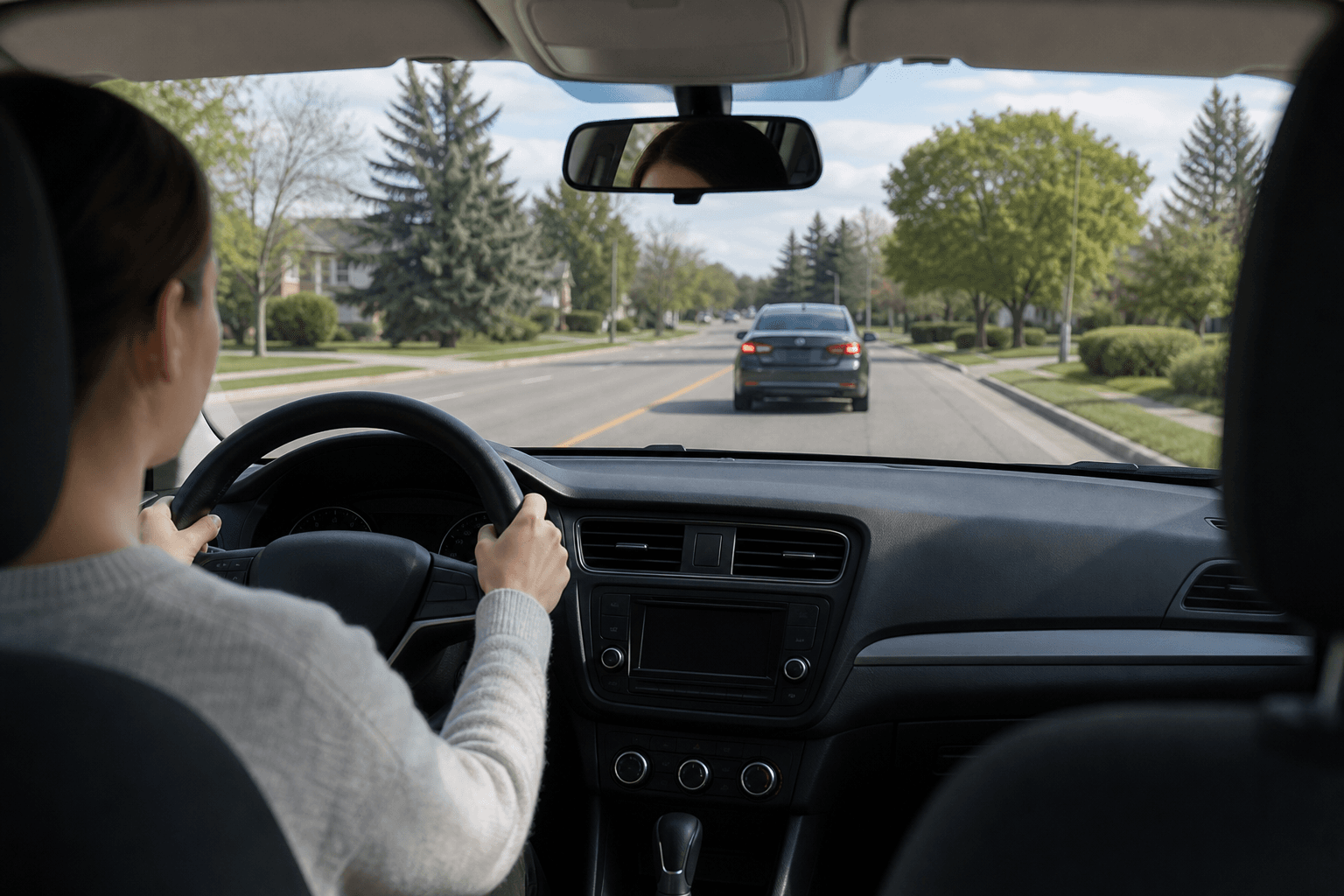


A nervous driver confidence plan is not an official Ontario programme or licence category. It is a personalized approach to building control, judgement, and confidence in manageable stages. The goal is not simply to drive more often, but to practise the right skill at the right pace with useful feedback.
A suitable plan may begin in a quiet area, progress to urban traffic and defensive decision-making, and then add highway practice or road-test preparation. Ontario’s official handbook covers road rules, safe driving practices, licensing information, and guidance for drivers who feel nervous. Read the official MTO Driver’s Handbook alongside practical instruction.
Quick summary

- Start at a level you can manage safely, then increase complexity gradually.
- Regular weekly lessons and spaced repetition may suit nervous learners better than an intense schedule.
- Choose one-on-one instruction when you need individualized pacing, correction, or confidence-building feedback.
- Build confidence through scanning, space management, hazard anticipation, and safer decisions.
- Before booking, confirm lesson length, instructor continuity, package terms, scheduling, and readiness assessment.
What a nervous driver confidence plan should include
Your plan should reflect your experience, licence stage, driving concerns, and available time. A beginner starting from zero needs a different progression from a licensed driver returning after a long break or a learner who mainly fears busy intersections.
Depending on your needs, the plan might involve individual lessons, refresher driving lessons, defensive driving training, theory instruction, or a multi-lesson package. If you want the standardized structure of a government-approved Beginner Driver Education course, verify that the school and programme meet Ontario’s requirements. Approved schools have requirements for classroom and in-vehicle training, but not every private lesson is automatically a BDE programme. Check Ontario’s guidance on government-approved driving schools.
For a nervous learner, the quality of progression matters more than a fixed number of hours. An effective instructor should identify what causes difficulty, explain the next skill clearly, and adjust the pace when a foundation is not consistent.
A staged progression from nervous to more confident driving

Stage 1: Build basic vehicle control
Begin with seating position, mirrors, pedals, steering, braking, starting and stopping smoothly, and maintaining a manageable speed. A beginner may start in a quiet, low-traffic area until these controls require less conscious effort. This creates mental capacity for observation and decision-making later.
Stage 2: Add observation and simple traffic
Practise mirror checks, shoulder checks, signalling, turning, following signs, and maintaining a safe following distance. Move into simple local roads before introducing more demanding traffic. The aim is to increase difficulty in steps small enough for you to process instructions.
Stage 3: Practise urban decisions
Next, work on intersections, lane changes, lane positioning, parking, controlled stops, route decisions, and responding to other road users. Ask your instructor to identify recurring patterns, such as late mirror checks or hesitation at turns, rather than offering only general reassurance.
Stage 4: Make confidence safer through defensive driving
Defensive driving training should connect confidence with safer behaviour. Practise scanning ahead, recognizing hazards early, managing space around the vehicle, controlling speed, communicating clearly, and choosing a lower-risk option when conditions change. Ontario driver-training guidance includes risk perception, risk management, defensive techniques, freeway driving, night driving, and adverse conditions.
Adding defensive driving training can help replace uncertainty with practical skills such as hazard-perception practice and safe space management. Confidence should improve judgement, not encourage risks you would previously have recognized as unsafe.
Stage 5: Add highway practice when relevant
Highway practice should come after you can control the vehicle and make reasonably consistent decisions in ordinary traffic. It may include merging, selecting safe gaps, maintaining speed and lane discipline, changing lanes at higher speeds, taking exits, and responding calmly to changing traffic.
Stage 6: Connect practice to test readiness
When your goal is a G2 or G test, shift from broad confidence-building to specific preparation. Include realistic routes, examiner-style instructions, repeated practice of weak areas, and a discussion about whether your skills are consistent enough for the test environment.
Choosing the right lesson pace for your confidence level
Regular weekly lessons can provide repetition without making every day feel like a driving challenge. They also leave time to process feedback and, where legally and safely possible, practise with a qualified accompanying driver. For many nervous learners, regular weekly lessons and spaced repetition can build confidence without the fatigue of an overly compressed schedule.
An intensive schedule may suit a developing driver with a clear test date, reliable basic control, and enough time to practise consistently. However, several demanding sessions close together may overwhelm a beginner. A faster calendar is useful only when the learner can absorb feedback and maintain safe performance.
Ask whether the proposed schedule includes breaks, repetition, and a way to slow down if anxiety or fatigue affects concentration. Ontario guidance advises drivers to be comfortable with their physical, mental, and emotional state before driving. See Ontario’s guidance on getting ready to drive.
Individual lessons, packages, and structured programmes
One-on-one driving lessons can be useful when you need personalized coaching, real-time correction, or a pace adapted to your concerns. They also make it easier to address a specific fear, such as left turns, heavy traffic, parking, or highway merging. One-on-one driving lessons may be a sensible starting point when you are unsure which skills need the most attention.
| Situation | May suit you | Confirm before booking |
|---|---|---|
| Starting from zero | Individual lessons or a structured beginner package | How the plan progresses from quiet areas to traffic |
| Returning after a break | A refresher assessment and targeted lessons | Whether training focuses on your actual gaps |
| Fear of busy traffic | One-on-one coaching with gradual exposure | How routes and pace will be controlled |
| Preparing for G2 | Lessons covering control, observation, traffic, parking, and lane changes | Whether realistic test skills and readiness feedback are included |
| Preparing for G | Targeted preparation with highway practice | Whether merging, exits, lane discipline, and speed management are included |
| Limited availability | An intensive or flexible schedule, if manageable | Session length, fatigue planning, and package expiry |
Packages may offer structure and clearer budgeting, while individual lessons provide flexibility when your needs are uncertain. Before paying, request the total lessons or hours, session length, inclusions, cancellation terms, and whether the plan can change after an initial assessment.
Build confidence through safer decisions
Confidence is more useful when it improves observation and judgement. Practise identifying hazards early, preserving space, managing speed, communicating clearly, and choosing safer options when traffic or weather changes.
Beginner driver education standards emphasize risk perception, risk management, and appropriate driving habits. A learner should become more capable without becoming overconfident. Feedback should continue even after familiar routes feel comfortable.
Match the plan to your G2 or G goal
G2 road test preparation generally needs strong vehicle control, observation, intersections, lane changes, parking, speed management, and communication with other road users. The plan should correct recurring habits rather than focus only on memorizing a route.
G road test preparation adds higher-speed decision-making. Highway merging, selecting safe gaps, lane discipline, exits, and maintaining appropriate speed may require focused practice. If your confidence plan leads toward a full licence, a G road test preparation plan can connect general practice with pre-test lessons, vehicle checks, and an MTO-aligned checklist.
Neither a package nor a lesson schedule guarantees a test result. Readiness should be based on consistent, safe performance across different situations, not one unusually successful lesson.
What to ask before booking nervous driver training
- How do you assess a nervous learner’s starting point?
- Can the pace be adjusted if I feel overwhelmed?
- How long is each lesson, and how much time is active instruction?
- Will I work with the same instructor?
- How do you give feedback on recurring errors?
- Do lessons cover defensive driving, hazard perception, and safe space management?
- Can the schedule include evenings or weekends?
- What is included in an individual lesson or package?
- What are the cancellation, rescheduling, and expiry terms?
- How will you decide when I am ready for G2 or G preparation?
Give the school your licence stage, previous experience, preferred area, availability, and specific concerns. A driving school serving Mississauga, Brampton, and the GTA should also clarify meeting or pickup arrangements. Before committing to a package, ask for the terms in writing.
When ordinary driving lessons may not be enough
Driving lessons provide instruction, practice, and coaching, but they are not medical or psychological treatment. If panic, fatigue, medication effects, or another physical or emotional concern could affect safe vehicle control, do not drive until you have appropriate advice.
Ontario states that drivers should not have a medical, emotional, nervous, or physical condition that significantly interferes with safe driving. Persistent or serious concerns may require support beyond routine instruction, including advice from an appropriate health professional or a formal driving assessment. Review Ontario’s medical review guidance if that boundary may apply to you.
A broader view of behavioural confidence and risk
Confidence can change how a driver interprets familiar situations. Continue using instructor feedback and deliberate observation rather than assuming that a previously manageable situation will always be safe. For additional reading on behavioural patterns and risk recognition, see how behavioural baselining can affect risk recognition. This is additional reading, not Ontario driving guidance.
Frequently asked questions
How many driving lessons does a nervous driver need?
There is no reliable number for every learner. Experience, time away from driving, confidence, traffic exposure, licence goal, and practice consistency all matter. Ask for an assessment and a staged plan with clear skills to review.
Are weekly lessons better than intensive lessons for driving anxiety?
Weekly lessons are often easier to process because they allow repetition and recovery. Intensive lessons can suit some developing drivers with a clear goal, but they should not create fatigue or overload. Choose the pace that supports safe, consistent performance.
Should a nervous beginner practise highway driving right away?
Usually, highway practice should follow basic vehicle control and manageable urban driving. An instructor should decide when you can safely focus on merging, speed, gaps, and lane discipline.
Can one-on-one lessons help if I have not driven for years?
They can provide a focused assessment and help rebuild specific skills. A refresher learner may need vehicle-control practice, urban traffic experience, highway work, or confidence rebuilding, but not necessarily a complete beginner programme.
What should I tell an instructor about driving anxiety?
Explain what triggers it, how it affects your driving, your experience, the situations you avoid, your licence goal, and your preferred pace. This helps the instructor sequence skills and choose suitable routes.
Conclusion: Choose a manageable next step
The strongest nervous driver confidence plan is gradual, individualized, and based on observable skills. Start at a level you can manage safely, build control and observation, add defensive decision-making, and introduce busier roads or highways when the foundation is ready.
For learners in Mississauga, Brampton, and the GTA, compare instructors by teaching style, pacing, feedback, lesson terms, and suitability for your G2 or G goal. Khurana Driving School describes patient, personalized instruction for nervous drivers, individual lessons, defensive driving training, road-test preparation, and flexible evening and weekend scheduling. Discuss your starting point and concerns before choosing the next lesson.